
| Disclosure: This post may contain affiliate links. As an Amazon Associate, I earn from qualifying purchases at no extra cost to you. |
A dangerous man watches a woman from the shadows.
He knows where she lives. He follows her routine. He may lie to her, manipulate her, imprison her, or convince her that she cannot trust her own mind.
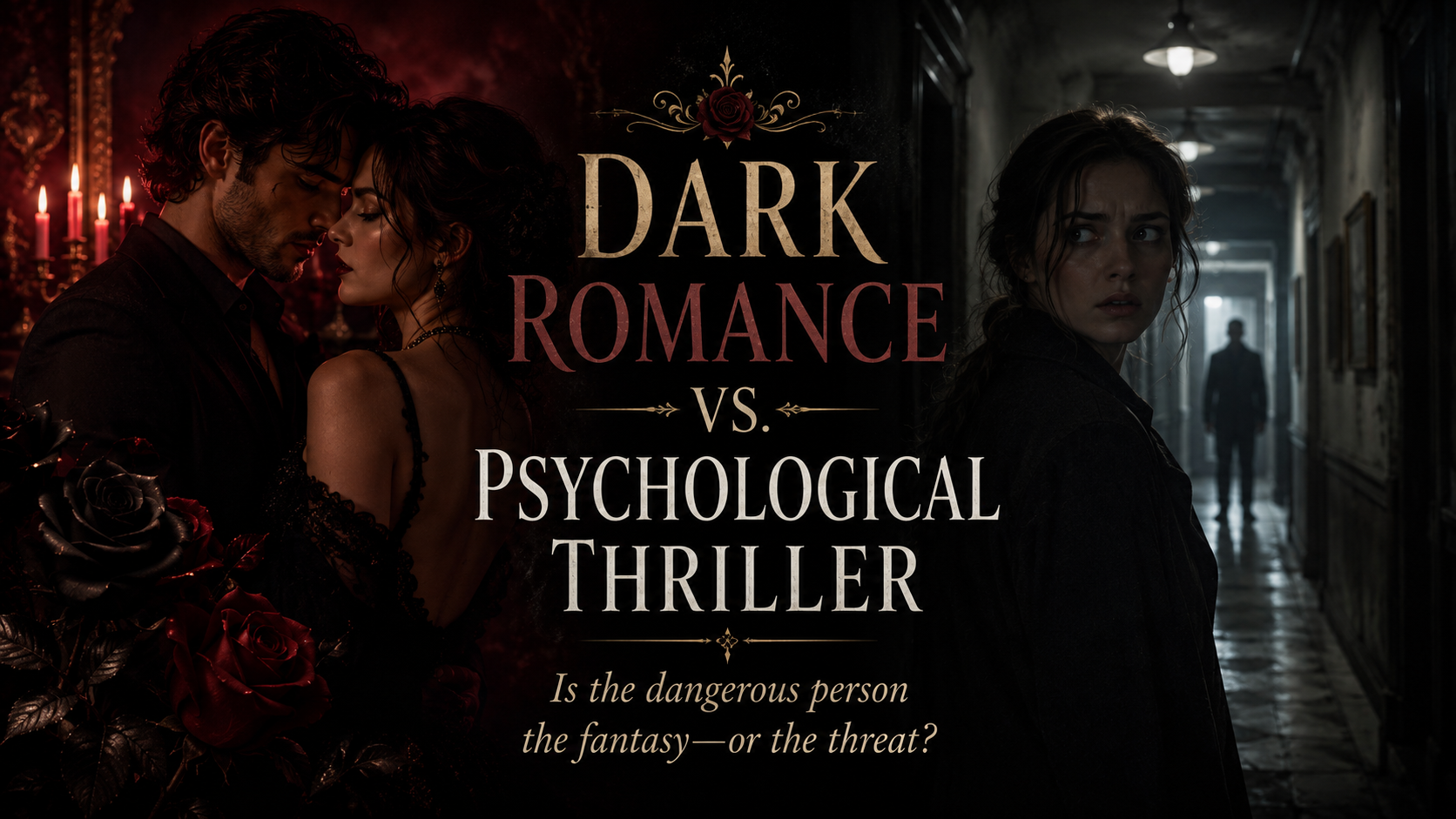
That description could belong to a dark romance or a psychological thriller.
The difference is not necessarily what happens.
The difference is what the story asks you to feel about it.
In dark romance, the dangerous relationship is usually the emotional center of the story. The reader is invited to become invested in the attraction, obsession, power struggle, or eventual bond between the main characters.
In a psychological thriller, the dangerous relationship is more likely to be the threat. The reader is invited to question motives, search for lies, anticipate betrayal, and wonder who will survive.
Both genres can contain obsession, stalking, murder, captivity, manipulation, morally gray characters, unreliable narrators, and deeply unhealthy relationships. However, they make very different promises to their readers.
This guide breaks down dark romance vs. psychological thriller, explains where the genres overlap, and helps you decide which one belongs on your reading list.
Dark Romance vs. Psychological Thriller at a Glance
| Category | Dark Romance | Psychological Thriller |
|---|---|---|
| Main focus | The romantic or sexual relationship | Suspense, danger, deception, or psychological conflict |
| Central question | Will these characters end up together? | What is really happening, and who can be trusted? |
| Typical antagonist | May be the love interest | Usually threatens, deceives, or controls the protagonist |
| Romance | Essential to the story | Optional or secondary |
| Attraction to the dangerous character | Often encouraged | Usually treated with suspicion |
| Ending expectation | Usually emotionally or romantically satisfying | May be tragic, ambiguous, shocking, or disturbing |
| Common reader experience | Tension, longing, fascination, emotional intensity | Suspicion, dread, anxiety, curiosity |
| Common structure | Relationship-driven | Plot- or mystery-driven |
| Sexual content | Often explicit, but not always | Usually secondary and may be minimal |
| Biggest payoff | Emotional surrender, commitment, possession, or redemption | Revelation, escape, justice, revenge, or a final twist |
The simplest distinction is this:
Dark romance asks whether love can survive the darkness. A psychological thriller asks what the darkness is hiding.
What Is Dark Romance?
Dark romance is a romance subgenre that explores relationships involving danger, taboo desires, extreme power imbalances, morally questionable behavior, or characters who would normally be considered villains.
The defining feature is not simply that something disturbing happens. The defining feature is that the romantic relationship remains central.
A dark romance may include:
- Obsession
- Stalking
- Kidnapping or captivity
- Revenge
- Criminal organizations
- Blackmail
- Forced proximity
- Dubious or complicated consent
- Possessive behavior
- Manipulation
- Violence
- Taboo relationships
- Morally gray or villainous love interests
The main characters may frighten, betray, control, or hurt each other. The relationship may be unhealthy by real-world standards. Nevertheless, the narrative asks readers to emotionally invest in that relationship.
Dark romance does not necessarily approve of everything its characters do. It creates a fictional space in which readers can explore danger, surrender, power, fear, obsession, and forbidden attraction without endorsing those behaviors outside the story.
What makes a book a romance?
A true genre romance normally places the romantic relationship at the center of the narrative and provides an emotionally satisfying resolution for the couple.
That resolution may not look sweet, conventional, or healthy.
In dark romance, “happily ever after” could mean:
- They escape together.
- They take over a criminal empire.
- The villain destroys everyone except the person he loves.
- The heroine chooses the darkness willingly.
- Two deeply damaged people create a life that makes sense only to them.
- The obsessive character never becomes good but becomes loyal.
The relationship does not have to become normal. It generally has to feel complete.
What Is a Psychological Thriller?
A psychological thriller is a suspense-driven story in which danger comes largely from the mind, behavior, motives, or perceptions of its characters.
Instead of relying only on physical action, psychological thrillers often create tension through:
- Manipulation
- Deception
- Gaslighting
- Paranoia
- Obsession
- Memory gaps
- Hidden identities
- Unreliable narrators
- Domestic secrets
- Moral corruption
- Shifting realities
- Fear of losing control
Psychological thrillers frequently revolve around unstable perceptions and concealed motives. The most important questions often concern what characters believe, what they remember, and whether their version of reality can be trusted.
Thrillers are generally driven by suspense and the possibility of future danger. Their primary goal is to make readers feel unsettled, anxious, and compelled to discover what happens next.
A psychological thriller may contain romance, sex, marriage, jealousy, or obsession. However, the relationship does not have to succeed.
It may end with:
- Escape
- Arrest
- Murder
- Revenge
- Exposure
- Betrayal
- Institutionalization
- A devastating revelation
- A final twist that changes everything
The relationship is often the trap—not the reward.
The Biggest Differences Between Dark Romance and Psychological Thrillers
1. Dark romance centers the relationship
In dark romance, the relationship is the main event.
There may be murders, conspiracies, family secrets, criminal enemies, or elaborate revenge plots, but the emotional core remains the connection between the central characters.
Readers are watching for:
- The first moment of vulnerability
- The first jealous reaction
- The first confession
- The moment hatred turns into desire
- The point at which obsession becomes attachment
- The moment one character chooses the other over everything else
A psychological thriller may also contain an intense relationship, but the plot is usually centered on uncovering the truth, escaping danger, or defeating someone.
The test
Remove the romantic relationship from the book.
If the entire story collapses, it is probably romance.
If the mystery, danger, or psychological conflict still functions, it is probably a thriller.
2. A dangerous man may be the romantic fantasy—or the threat
Both genres frequently feature charismatic, secretive, controlling, or dangerous men.
The narrative framing makes the difference.

In dark romance:
The reader may be encouraged to fear him and desire him simultaneously.
His obsessive behavior can become part of the fantasy. The tension comes from wondering whether he will hurt the heroine, protect her, surrender to her, or destroy anyone who stands between them.
In a psychological thriller:
His charm is more likely to be a warning.
The tension comes from wondering what he has done, what he plans to do, and whether the protagonist will recognize the danger before it is too late.
A dark-romance hero might say, “You belong to me,” and the scene is designed to produce a thrill.
A thriller villain might say the same words, but the scene is designed to make the reader look for an exit.
3. Dark romance promises emotional investment
Dark romance asks readers to become invested in a relationship they might condemn in reality.
The reader may know the love interest is dangerous. There may be no question that he lies, manipulates, stalks, or kills. The suspense does not always come from discovering whether he is dangerous.
It comes from discovering:
- Why he wants this particular person
- Whether his obsession has limits
- Whether he is capable of tenderness
- What could make him lose control
- Whether the heroine will resist, escape, submit, or become equally dangerous
Psychological thrillers generally create distance between the reader and the threatening character. Even when the villain is seductive, the reader is encouraged to examine the seduction for evidence of deception.
4. Psychological thrillers prioritize uncertainty
Psychological thrillers thrive on questions.
Who is lying?
Did the narrator imagine what happened?
Is the husband protecting his wife or controlling her?
Was the disappearance planned?
Is the victim actually the villain?
Can the protagonist trust her own memory?
Dark romance can contain mysteries and twists, but readers often understand the central emotional dynamic earlier. They may know who the obsessive character is and what he wants. The uncertainty concerns what he will do about it.
In a thriller, the reader may not even know who the real danger is until the final chapters.
5. The two genres handle toxic relationships differently
Dark romance may intentionally romanticize or eroticize behavior that would be dangerous in real life.
That does not mean every reader interprets the behavior literally. For many readers, the appeal lies in the intensity, absolute devotion, forbidden fantasy, or controlled experience of fear.
Psychological thrillers are more likely to expose toxic behavior.
A controlling relationship may initially look romantic, only for the story to reveal how isolation, manipulation, financial control, surveillance, or emotional abuse gradually trapped the protagonist.
The same action can therefore serve opposite purposes.
| Scenario | Dark-romance framing | Psychological-thriller framing |
|---|---|---|
| He follows her home | Proof of obsession | Evidence she is in danger |
| He isolates her | Forced intimacy or possession fantasy | Escalating abuse |
| He tracks her phone | Protective or controlling devotion | Surveillance |
| He lies about his identity | Dangerous mystery surrounding the hero | Central deception to uncover |
| He kills for her | Extreme loyalty | Proof that she must escape |
| She stays with him | Acceptance of their dark bond | Potentially a tragic failure to escape |
| He says no one else can have her | Possessive declaration | Threat of violence |
6. The endings make different promises
This is one of the most important differences.
A reader picking up a dark romance generally expects the central relationship to receive a meaningful romantic resolution. It may be unconventional, violent, or morally messy, but the couple is usually meant to feel chosen.
A psychological thriller makes no such promise.
The romantic partner may be:
- The killer
- The manipulator
- The next victim
- An accomplice
- A false identity
- A projection
- Completely innocent
- Dead before the story begins
The ending of a thriller serves the suspense plot first.
The ending of a dark romance serves the relationship first.
Why Dark Romance and Psychological Thrillers Feel So Similar
These genres attract many of the same readers because both create intensity.
Neither genre depends on safe, ordinary, low-stakes relationships. Both may explore what happens when desire, fear, trauma, control, and obsession become impossible to separate.
They also share several popular elements.
Obsession
Obsession creates relentless attention.
In dark romance, being the sole focus of a dangerous character can function as a fantasy of being chosen above everyone else.
In a thriller, that same attention becomes suffocating. The character is not being cherished. She is being studied.
Unreliable narrators
A dark romance narrator may deny her attraction, misunderstand the hero’s motives, or hide her own dangerous desires.
A thriller narrator may have missing memories, altered perceptions, trauma, addiction, or deliberate reasons for misleading the reader.
Isolation
Remote estates, locked rooms, secluded cabins, empty roads, private islands, and unfamiliar towns appear in both genres.
Dark romance uses isolation to intensify intimacy.
Psychological thrillers use it to eliminate escape.
Power imbalance
One character may have more money, status, knowledge, physical strength, social influence, or emotional control.
Dark romance often uses that imbalance to create erotic or emotional tension.
A thriller uses it to create vulnerability.
Moral ambiguity
Both genres allow readers to spend time inside the minds of people who lie, manipulate, obsess, harm others, or justify terrible decisions.
Dark romance asks whether such a character can love.
Psychological thrillers ask whether such a character can be believed.
Dark Romance vs. Romantic Suspense vs. Psychological Thriller
These categories are often confused, but they are not interchangeable.
Dark romance
The relationship is central, and the romantic fantasy includes dark, taboo, dangerous, or morally complicated elements.
Romantic suspense
Romantic suspense combines a central love story with an external mystery, crime, or threat. The couple may investigate a murder, escape a stalker, expose a conspiracy, or survive an attack together.
Unlike many dark romances, the love interest is usually not the primary threat. He may instead function as the protector, investigator, partner, or fellow target. Romantic suspense deliberately intertwines the relationship with a mystery or thriller plot.
Psychological thriller
The suspense and psychological conflict come first. A romantic relationship may be important, but the story does not owe the couple a happy ending.
An easy way to remember it
- Dark romance: The dangerous person is the love story.
- Romantic suspense: The couple faces the danger together.
- Psychological thriller: The person closest to you may be the danger.

Is Verity a Dark Romance or a Psychological Thriller?
This is one of the most common genre-confusion questions.
Verity by Colleen Hoover contains sexual content, romantic tension, disturbing relationships, obsession, manipulation, and morally questionable characters.
However, it is better classified as a romantic psychological thriller than a traditional dark romance.
The mystery surrounding Verity, Jeremy, Lowen, and the manuscript drives the book. Its central promise is not simply that a dark couple will achieve a satisfying romantic resolution. Its appeal comes from doubt, competing versions of the truth, and an ending designed to make readers question what they believe.
This is a useful example of a book that can appeal to dark-romance readers without fully following dark-romance rules.
Does Dark Romance Have to Have a Happy Ending?
Generally, a book marketed as a genre romance should provide an emotionally satisfying ending for the central romantic relationship.
That does not always require:
- Marriage
- Babies
- Redemption
- Therapy
- Forgiveness
- A conventional domestic life
It does usually require the relationship to reach a state that feels intentional and complete.
If the protagonist permanently escapes the dangerous love interest, exposes him, kills him, and begins rebuilding her life, the story may be excellent—but it is more likely a thriller, horror novel, or dark psychological drama than a dark romance.
A tragic love story can be romantic without belonging to the commercial romance genre.
Does a Psychological Thriller Have to Include Murder?
No.
Psychological thrillers need sustained danger, tension, manipulation, or mental conflict, but murder is not required.
The threat could involve:
- A stolen identity
- A hidden affair
- A missing child
- A false accusation
- Memory manipulation
- Gaslighting
- Blackmail
- Financial control
- A secret second family
- A fabricated illness
- A dangerous therapist
- A workplace conspiracy
- A marriage built on lies
The danger may be physical, emotional, legal, social, or psychological.
Is Dark Romance the Same as Horror?
No, although some books blend both genres.
Horror primarily tries to frighten, disturb, or horrify the audience.
Dark romance primarily tries to create emotional and romantic investment in a dark relationship.
A horror novel may contain sex, desire, obsession, or even a love story. However, if fear and horror remain the book’s dominant promise, it is not automatically dark romance.
Similarly, a dark romance can contain violence and terrifying scenes without becoming a horror novel.
Ask what the reader is waiting for:
- The couple’s emotional surrender?
- The monster’s next appearance?
- The killer’s identity?
- The heroine’s escape?
- The final romantic commitment?
The answer usually reveals the genre.

Which Genre Should You Read?
Choose dark romance if you like:
- Morally gray or villainous love interests
- “Touch her and die” behavior
- Obsessive devotion
- Possessive heroes
- Enemies-to-lovers tension
- Dangerous sexual chemistry
- Forbidden or taboo relationships
- Power struggles
- Characters who become worse together
- High spice levels
- Emotional intensity
- A relationship-centered payoff
- Happily-ever-after endings with sharp edges
Dark romance is ideal when you want to think:
This relationship is completely unhinged, but I need them to end up together.
Choose psychological thrillers if you like:
- Unreliable narrators
- Shocking twists
- Missing people
- Marriages full of secrets
- Gaslighting plots
- Domestic suspense
- Revenge stories
- Female rage
- Manipulative characters
- Identity deception
- Locked-room settings
- Murder investigations
- Ambiguous endings
- Trying to predict the villain
- Realizing you trusted the wrong person
Psychological thrillers are ideal when you want to think:
Something is deeply wrong here, and I need to know the truth.
Choose romantic suspense if you like:
- A real central romance
- A protective love interest
- Criminal investigations
- Stalkers or killers threatening the couple
- Survival plots
- Bodyguards
- Witness protection
- Couples solving mysteries together
- Danger without making the hero the primary villain
- Both romantic and suspenseful resolution
Romantic suspense is ideal when you want:
A love story in which the couple fights the monster together.
Choose a dark romantic thriller if you like:
- Attraction mixed with suspicion
- A love interest who may be lying
- Obsessive relationships
- Murderous couples
- Cat-and-mouse seduction
- Romantic tension without a guaranteed happy ending
- Twists involving lovers, spouses, or exes
- Characters who might betray or destroy each other
- A story that refuses to tell you whether the relationship is love or manipulation
This crossover category is ideal when you want both:
I want them together—and I am afraid of what will happen if they are.
Keep Track of Every Dark and Twisted Read
Once you start moving between dark romance and psychological thrillers, your reading list can grow alarmingly fast. A physical reading counter makes it easy to track how many books you finish throughout the year while doubling as bookish shelf décor.
The Books Read This Year Counter uses replaceable number cards so readers can update their total as they complete each new obsession.
Track Your Books Read This Year on Amazon
Dark Romance vs. Psychological Thriller Comparison List
Use this list when you are choosing your next book.
Read dark romance when you want:
- The villain to become the love interest.
- Obsession to feel seductive.
- The relationship to receive the biggest emotional payoff.
- Explicit chemistry and sexual tension.
- A dangerous character who is loyal to one person.
- Possession, jealousy, and extreme devotion.
- The heroine to embrace the darkness.
- A conclusion that rewards the central relationship.
- Fantasy over realism.
- Emotional intensity that feels almost addictive.
Read a psychological thriller when you want:
- The charming man to become a suspect.
- Obsession to feel claustrophobic.
- The truth to provide the biggest payoff.
- Suspicion and psychological tension.
- A character whose loyalty cannot be trusted.
- Secrets, betrayal, and hidden motives.
- The protagonist to expose or escape the darkness.
- A conclusion that may destroy the relationship.
- Plausible real-world danger.
- A twist that changes how you interpret the entire book.
Books for Psychological-Thriller Readers Who Are Curious About Darker Relationships
The following titles were selected because they were not included in the provided exclusion list.
1. Gone Girl by Gillian Flynn
Best for: Readers who want marriage, manipulation, resentment, obsession, and two people capable of psychologically destroying each other.
This is not a traditional dark romance. It is a psychological thriller about a toxic marriage in which love, hatred, performance, revenge, and dependence become inseparable.
Read it when you want a relationship that feels like psychological warfare.
Romance level: Low
Psychological tension: Extreme
Darkness level: High
Primary appeal: Unreliable narration, marriage secrets, revenge
2. The Silent Patient by Alex Michaelides
Best for: Readers who enjoy obsession, dangerous curiosity, buried trauma, and narrators with hidden motives.
A famous painter refuses to speak after being accused of murdering her husband. A psychotherapist becomes determined to uncover the reason for her silence.
Romance level: Low
Psychological tension: High
Darkness level: Moderate to high
Primary appeal: Therapy setting, obsession, major twist
3. The Housemaid by Freida McFadden
Best for: Readers who enjoy domestic power games, hidden identities, wealthy households, dangerous marriages, and rapidly shifting loyalties.
A woman accepts a live-in housekeeping job with a seemingly perfect family and quickly realizes that everyone in the house is hiding something.
The book is firmly a psychological thriller, but its secrets, controlling relationships, and morally complicated characters may appeal to dark-romance readers.
Romance level: Low
Psychological tension: High
Darkness level: Moderate
Primary appeal: Domestic suspense, reversals, addictive pacing
4. Verity by Colleen Hoover
Best for: Readers who want a bridge between romance and psychological suspense.
A struggling writer is hired to complete a bestselling author’s series and discovers a disturbing manuscript inside the author’s home.
The attraction is important, but the mystery surrounding the manuscript and the truth about the marriage remains the dominant force.
Romance level: High
Psychological tension: High
Darkness level: High
Primary appeal: Forbidden attraction, disturbing manuscript, ambiguous truth
5. Behind Closed Doors by B.A. Paris
Best for: Readers who want to see how a relationship that looks perfect from the outside can become a nightmare in private.
This is the reverse of a possessive dark-romance fantasy. The controlling husband is not an antihero waiting to reveal a tender side. He is the danger.
Romance level: Very low
Psychological tension: High
Darkness level: High
Primary appeal: Domestic imprisonment, coercive control, survival
6. The Kind Worth Killing by Peter Swanson
Best for: Readers who enjoy seductive strangers, morally corrupt characters, murder plots, and shifting alliances.
A chance meeting between two strangers leads to a conversation about murder. From there, motives multiply and trust becomes increasingly dangerous.
Romance level: Low
Psychological tension: High
Darkness level: High
Primary appeal: Murder conspiracy, betrayal, morally gray characters
7. The Last Mrs. Parrish by Liv Constantine
Best for: Readers who like jealousy, wealth, calculated seduction, marriage secrets, and women with competing agendas.
A woman becomes fixated on a wealthy couple and carefully inserts herself into their lives.
Romance level: Low
Psychological tension: High
Darkness level: Moderate
Primary appeal: Social manipulation, envy, marriage deception
8. The Wife Between Us by Greer Hendricks and Sarah Pekkanen
Best for: Readers who enjoy love triangles that are not what they appear to be.
The book deliberately encourages assumptions about a jealous ex-wife, a new fiancée, and the man between them—then begins dismantling those assumptions.
Romance level: Low
Psychological tension: High
Darkness level: Moderate
Primary appeal: Misdirection, toxic relationships, shifting perspectives
9. The Butterfly Garden by Dot Hutchison
Best for: Readers who can tolerate extremely disturbing captivity themes and want a thriller rather than a romanticized captor story.
A survivor recounts what happened inside a hidden garden where young women were collected and imprisoned.
This is not a romance. Readers should examine content warnings carefully.
Romance level: None
Psychological tension: High
Darkness level: Extreme
Primary appeal: Captivity, survival, disturbing villain
10. Rock Paper Scissors by Alice Feeney
Best for: Readers who enjoy isolated settings, unhappy marriages, secret histories, and characters who do not know the full truth about one another.
A married couple takes a winter trip to a remote location in an attempt to repair their relationship. The isolation quickly exposes how much has been concealed.
Romance level: Low
Psychological tension: High
Darkness level: Moderate
Primary appeal: Snowed-in atmosphere, marriage secrets, twists
Can a Book Be Both Dark Romance and Psychological Thriller?
Yes.
Genre categories are not sealed rooms. A book can draw heavily from both.
A dark-romance psychological thriller may contain:
- A central relationship that receives a romantic resolution
- A mystery surrounding one or both love interests
- An unreliable narrator
- Stalking or surveillance
- A villainous romantic lead
- Psychological manipulation
- A threat involving identity or memory
- Twists that transform the relationship
- A romantic bond that remains central despite the suspense plot
The deciding factor is usually the final promise.
If the relationship is the destination, the book leans dark romance.
If uncovering the truth or surviving the danger is the destination, it leans psychological thriller.
If both receive nearly equal attention, the book may reasonably be marketed as a dark romantic thriller, romantic psychological thriller, or psychological dark romance.
Why Do Dark-Romance Readers Often Enjoy Psychological Thrillers?
The genres offer different outcomes but similar forms of stimulation.
Both provide:
- High emotional stakes
- Compulsive pacing
- Dangerous interpersonal dynamics
- Characters who cannot be taken at face value
- Intimacy mixed with fear
- Extreme behavior
- Secrets
- Betrayal
- Moral discomfort
- The possibility that love and danger are coming from the same person
There is also a growing appetite for stories involving female revenge, moral ambiguity, and women reclaiming control after manipulation or abuse. Contemporary thrillers, horror novels, and romances increasingly overlap in their treatment of power, fear, desire, and retaliation.
The major difference is the fantasy being fulfilled.
Dark romance fulfills the fantasy of being desired with terrifying intensity.
Psychological thrillers fulfill the fantasy of discovering the truth, outsmarting the threat, or taking back control.
Create a Cozy Reading-Night Setup
Whether you are settling in with an obsessive dark romance or a psychological thriller that will keep you awake far too late, the right reading setup can make the experience even better.
For younger readers or families creating a cozy reading corner, the Solfres Starry Weighted Blanket adds a galaxy-inspired look and gentle weighted comfort for quiet time, reading, or winding down.
View the Starry Weighted Blanket on Amazon
Frequently Asked Questions
Is dark romance considered a thriller?
Not automatically.
Dark romance can be suspenseful, violent, and psychologically intense, but it remains romance when the central relationship drives the story and receives an emotionally satisfying resolution.
Is psychological romance a real genre?
“Psychological romance” is used informally to describe relationship-focused fiction with intense character psychology, manipulation, obsession, trauma, or unstable perceptions.
Books with stronger suspense plots may be categorized as psychological thrillers, romantic thrillers, or romantic suspense.
Can a psychological thriller have explicit sex scenes?
Yes.
Sexual content does not determine genre. A psychological thriller can be explicit, but sex normally serves the characters, manipulation, atmosphere, or suspense plot rather than functioning as the book’s central genre promise.
Can dark romance have plot twists?
Absolutely.
Dark romance can include hidden identities, betrayals, family secrets, revenge plots, murders, conspiracies, and unreliable narrators. The presence of a twist does not turn a romance into a thriller.
Are dark romances supposed to be realistic?
Not necessarily.
Many dark romances operate through heightened fantasy. The emotions may feel real while the circumstances are deliberately extreme.
Readers should not assume that enjoying a fictional fantasy means wanting the same behavior in reality.
Is a stalker romance automatically dark romance?
Usually, but not always.
If the stalker is the romantic lead and the story asks readers to invest in the eventual relationship, it likely falls within dark romance.
If the protagonist’s goal is to expose, defeat, or escape the stalker, it is more likely suspense, thriller, or horror.
What is the difference between a dark-romance hero and a thriller villain?
A dark-romance hero is narratively positioned as a central object of romantic investment despite his actions.
A thriller villain is positioned as a threat whose motives must be exposed or whose control must be escaped.
A character may behave similarly in both genres. The framing and resolution change the meaning.
Which genre is scarier?
Psychological thrillers are generally more committed to creating fear, uncertainty, and dread.
Dark romance may contain scarier events, but attraction and emotional investment often soften or complicate the fear.
Which genre usually has more spice?
Dark romance usually contains more explicit sexual content, although spice levels vary widely.
Psychological thrillers may contain sex but are not required to deliver romantic or erotic satisfaction.
What should I read after dark romance?
Try psychological thrillers involving marriage secrets, obsessive relationships, manipulative partners, female revenge, domestic suspense, or unreliable narrators.
These themes preserve the intensity while shifting the payoff from romance to revelation.

Final Verdict: Dark Romance or Psychological Thriller?
Choose dark romance when you want the dangerous relationship to succeed.
Choose a psychological thriller when you want the dangerous relationship exposed.
Choose romantic suspense when you want the couple to confront an outside danger together.
Choose a dark romantic thriller when you want to spend the entire book wondering whether the love interest will kiss the protagonist, save her, betray her, or kill her.
Ultimately, dark romance and psychological thrillers are neighboring genres separated by one crucial question:
Is the dangerous person the fantasy—or the reason you should run?
For more reading guides, explore:
- Dark Romance Tropes Explained
- Dark Romance FAQ
- Best Dark Romance Books of All Time
- Dark Romance Books With Unhinged Heroes
- Dark Romance Books With Possessive Male Leads
- 15 Dark Romance Sub-Niches to Explore Next
- Beginner Dark Romance Books
- Taboo Dark Romance Books
- Forced Marriage Dark Romance Books That Deliver Possession, Power, and Dangerous Vows
- Best Slow Burn Age Gap Romance Online (Free Dark Romance With Real Tension)
- Masked Men Dark Romance Books That Are Twisted, Spicy, and Impossible to Put Down
- The Evolution of Dark Romance: How Forbidden Love Became One of the Most Addictive Genres in Fiction
- Blackmail Romance Books For Readers Who Love Secrets, Leverage, And Dangerous Bargains
And when you want something original, visit the Eerie Efficiency Original Fiction Library for obsessive slow burns, forbidden relationships, morally complicated men, and romances that take their time crossing the line.