
Most productivity advice forgets something essential:
We’re not robots — we’re rituals in motion.
Every planner page, every unchecked box, every “lazy day” that spirals into guilt… these aren’t signs of failure. They’re messages from the shadow.
In psychology, “shadow work” is the practice of exploring the parts of ourselves we’ve repressed — the emotions, fears, and patterns we’d rather not see. But in the quiet, candlelit corners of your schedule, that shadow shows itself: the procrastination that protects you from rejection, the perfectionism that hides your fear of not being enough, the burnout that whispers, “slow down, before something breaks.”
This isn’t just about motivation. It’s about self-understanding.
Because when you heal the emotional roots of your productivity struggles, you don’t just work better — you become whole.
🕯️ The Witchy Psychology of Shadow Work
In Jungian terms, the “shadow” represents everything you’ve buried — impulses, desires, and emotions too complex or inconvenient for the version of you that plays nice with daylight.
But witches and mystics have known this long before it was psychological.
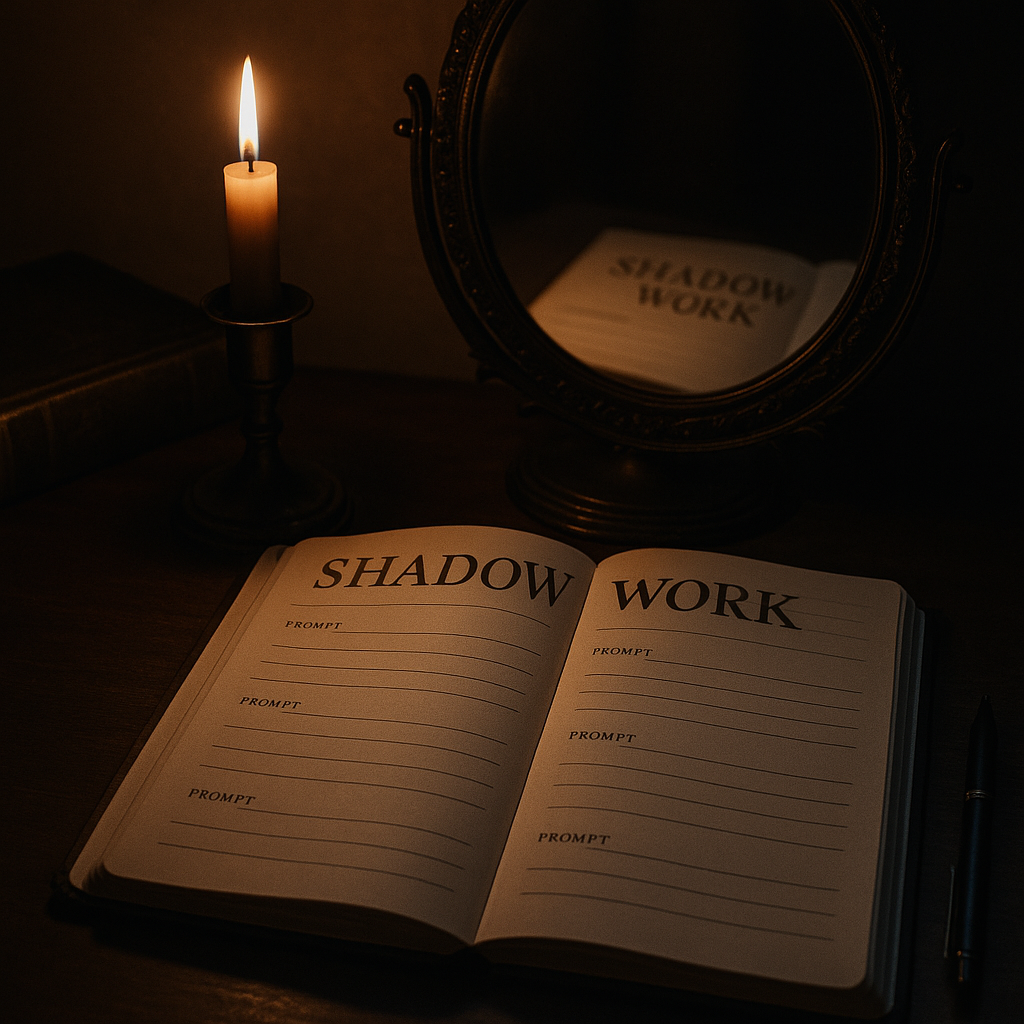
Shadow work, in its oldest form, is ritual reflection. It’s looking into the mirror by candlelight and asking, “What part of me am I avoiding?”
Dark academia romanticizes this beautifully: long nights of journaling by amber glow, books scattered like relics, silence heavy enough to hear your own thoughts. But underneath the aesthetic is a truth modern life desperately needs — introspection is productive.
🕯️ Eerie Efficiency Tip:
Light a candle, open your planner, and write one line:
“What emotion am I carrying into this week?”
If the answer feels uncomfortable, good — that’s your shadow pointing toward what needs healing.
Try keeping a few extra pages in your Shadow Work Journal Printable or the notes section of your Lunar Calendar Planner.
Use them for emotional inventory: guilt, resentment, exhaustion, and glimmers of joy — they all belong here.
Because the shadow isn’t the enemy of productivity; it’s the buried map of where your motivation went.

🪶 Productivity as a Mirror
Productivity culture often sells the illusion that efficiency equals virtue — that being busy means being worthy.
But the shadow doesn’t care about your to-do list. It wants honesty.
That “I just can’t focus” feeling? Sometimes it’s your body refusing to march past exhaustion.
That endless cycle of rewriting your goals? It’s perfectionism disguised as preparation.
That resentment toward work you once loved? It’s your intuition screaming for alignment.
Every time your planner overwhelms you, you’re being handed an invitation to pause.
“When you stop fearing stillness, your focus finally returns.”
🕯️ Ritual practice:
At the end of the day, instead of asking “Did I get enough done?”, try asking:
“What emotion did I avoid today — and what did it cost me?”
You might find that what you call procrastination is actually self-protection.
💀 Eerie Efficiency Tool:
Pair your emotional reflections with structure using the Gothic Productivity Planner Bundle.
Its habit-tracking spreads and reflection prompts help you observe behavior without judgment — like a scientist of your own psyche.
Because true productivity isn’t about control. It’s about awareness.
🌕 Rituals of Reflection
Every planner should double as a sacred space.
That’s how you turn self-discipline into self-devotion.
Try blending shadow work with your planning practice:
🌑 1. The Weekly Mood Forecast
Before setting goals, write a few words that describe your current energy: inspired, anxious, heavy, hopeful.
Then align your expectations with your capacity — not your ideal self, but your honest one.
🌒 2. The Mid-Cycle Check-In
Halfway through your lunar or monthly cycle, revisit your planner.
What tasks drain you? Which ones light you up?
Color-code or annotate your planner to track emotional resonance — notice patterns between the moon phases and your motivation.
🌕 3. The Full-Moon Reflection
Under the full moon, review what manifested and what must be released.
Ask yourself: What did I learn this cycle about my patterns? What still needs compassion?
🌘 4. The Waning-Moon Reset
As the moon darkens, so should your schedule.
Cut back. Reflect. Prepare for rebirth.
🪶 Eerie Efficiency Tip:
Use your Lunar Calendar Planner to sync these phases — each one marked with space for intention and release.
The moon becomes a built-in accountability partner, reminding you that rhythm matters more than relentless motion.

🖋️ Facing the Emotional Patterns Behind Burnout
Burnout doesn’t always mean you’re overworked.
Sometimes, it means you’ve been overriding your truth.
We push ourselves out of fear — fear of falling behind, fear of being ordinary, fear of disappointing others.
But the more we ignore our inner world, the louder the shadow becomes.
Shadow work teaches that burnout is an imbalance between inner needs and outer performance.
Your body keeps score. Your spirit keeps receipts.
💀 Eerie Efficiency Reflection:
Write the phrase:
“If I didn’t have to prove my worth, I would…”
Then finish it. Honestly.
That sentence often reveals the path back to aligned action — the kind that doesn’t require caffeine or self-criticism to maintain.
When you begin scheduling recovery as intentionally as effort, your shadow stops screaming for attention — because it’s finally being heard.
🌘 Reframing the Shadow
You’ve probably been taught to fight your unproductive days — to push through, to optimize, to hustle harder.
But every season of rest is a sacred part of the cycle.
The shadow doesn’t sabotage you; it protects you from overwhelm.
When you accept it, it becomes your ally.
“You are not lazy — you’re processing.”
Dark academia aesthetics celebrate this beautifully: the scholar who ponders before acting, the writer who stares out a rainy window and calls it work (because it is).
Reflection isn’t avoidance — it’s refinement.
🕯️ Try this practice:
When you notice yourself zoning out, instead of snapping back, ask:
“What am I avoiding right now — and what emotion lives beneath it?”
Then jot the answer in your planner’s margins or your Shadow Work Journal Printable.
Give the emotion a name. Naming is neutralizing — it transforms chaos into clarity.

🌗 Turning Planning Into Ritual
The reason so many people abandon planners isn’t because they lack discipline — it’s because their planners lack soul.
A to-do list without reflection feels hollow.
But when you turn your daily planning into a ritual — lighting a candle, choosing a page, aligning with the moon — you begin to associate productivity with peace instead of pressure.
In witchcraft, intention is everything.
So let every checkbox become a micro-spell: an affirmation of order, balance, and follow-through.
🕯️ Ritual suggestion:
Before beginning your day, place your hand on your planner and say,
“I release perfection. I choose progress. My energy follows purpose.”
That small act rewires your nervous system toward gentleness instead of guilt.
💀 Tool for transformation:
The Gothic Productivity Planner Bundle was designed with this in mind — moody aesthetics meet mindful structure.
Each page feels like a spellbook entry — proof that organization and intuition can coexist.
🌔 The Integration: Shadow and Schedule
Healing doesn’t mean abandoning structure; it means making space for both.
The light of your ambition and the dark of your reflection — both belong in your day.
Use your planner like a mirror:
- When your motivation fades, ask what it’s teaching you.
- When your focus sharpens, honor it as sacred fire.
- When you rest, let it be ritual, not regret.
🕯️ Eerie Efficiency mantra:
“Balance isn’t found in the light — it’s created in the shadows.”
If you can hold both ambition and awareness, you’ll find a kind of sustainable success that no burnout can touch.
🌕 Closing Ritual: Light the Candle, Not the Deadline
Tonight, before you close your laptop or phone, light a candle.
Open your planner — not to list tasks, but to honor yourself.
Write one sentence:
“Today I showed up for myself by…”
Maybe you rested. Maybe you cried. Maybe you simply noticed your emotions without judging them.
That counts. It all counts.
Because success isn’t just the visible output — it’s the invisible inner work that keeps you standing.
Your shadow doesn’t make you broken. It makes you complete.
✨ Eerie Efficiency Product Trio for Shadow Integration:
- Shadow Work Journal Printable — guided prompts for emotional clarity.
- Lunar Calendar Planner — align goals with lunar rhythm.
- Gothic Productivity Planner Bundle — structure meets spellwork.
Because planning isn’t just about doing more.
It’s about becoming more — through awareness, ritual, and grace. 🌒



2 Responses