
Disclosure: This post may contain affiliate links. As an Amazon Associate, I earn from qualifying purchases at no additional cost to you.
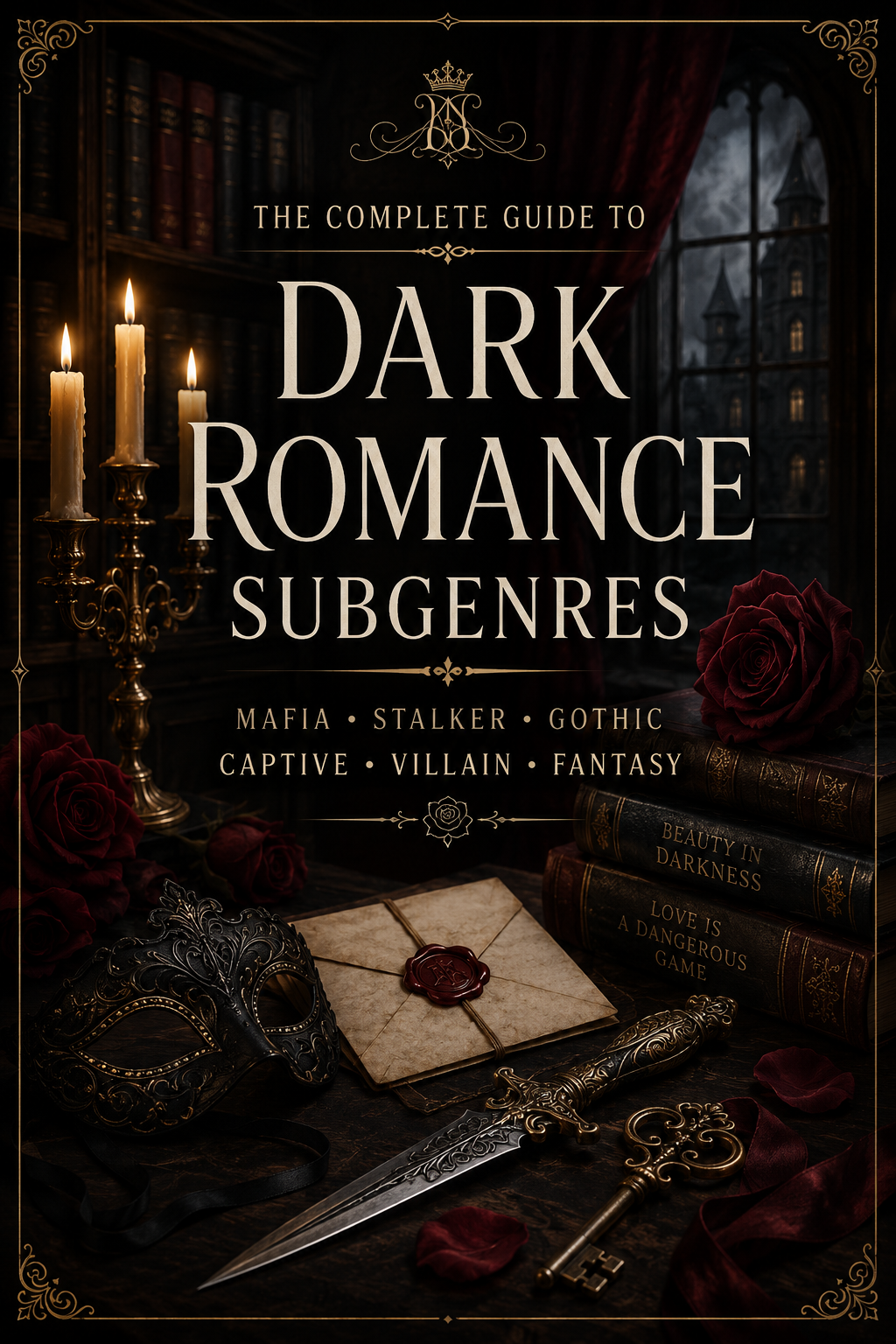
Dark romance is not one single type of story.
One reader may want a sophisticated mafia heir who controls an entire city. Another wants a masked stalker watching from the shadows. Someone else is searching for cursed castles, brutal fantasy kingdoms, serial killers, secret societies, captive heroines, or emotionally devastating relationships that feel disturbingly realistic.
All of those books may be labeled dark romance, but they do not create the same reading experience.
That is where dark romance subgenres become important.
Subgenres tell you where the darkness comes from:
- Organized crime
- Obsession
- Psychological manipulation
- Captivity
- Violence
- Forbidden relationships
- Supernatural danger
- Institutional power
- Trauma
- Revenge
- Survival
- Morally corrupt characters
Some subgenres overlap heavily. A book can be a mafia romance, forced-marriage romance, captive romance, and enemies-to-lovers story at the same time. However, one source of conflict usually determines the book’s dominant atmosphere.
This complete guide breaks down the most important dark romance subgenres, how they differ, what readers love about them, what content they may contain, and which type of reader is most likely to become obsessed with each one.
Content note: Dark romance may include violence, stalking, coercion, abuse, captivity, trauma, manipulation, criminal activity, dubious consent, non-consent, sexual violence, death, and psychologically disturbing material. Always review individual trigger warnings before reading.
Quick Dark Romance Subgenre Finder
| You want… | Start with… |
|---|---|
| Wealth, criminal power, and possessive men | Mafia romance |
| A hero who watches, follows, or tracks the heroine | Stalker romance |
| Manipulation and emotional mind games | Psychological dark romance |
| Kidnapping and inescapable forced proximity | Captive romance |
| A dangerous man who is genuinely the villain | Villain romance |
| Revenge, murder, and morally corrupt protagonists | Serial-killer or revenge romance |
| Rituals, elite schools, and powerful organizations | Secret-society romance |
| Curses, castles, ghosts, and haunted atmosphere | Gothic romance |
| Monsters, demons, and supernatural danger | Paranormal or monster dark romance |
| Brutal kingdoms and morally black rulers | Dark fantasy romance |
| Clubs, territorial men, and outlaw loyalty | Motorcycle-club romance |
| Dangerous authority figures and institutional control | Prison or institutional romance |
| Socially forbidden relationships | Taboo romance |
| Multiple dangerous love interests | Dark why-choose romance |
| Painful realism and emotionally destructive relationships | Contemporary psychological romance |

1. Mafia Dark Romance
Mafia romance combines a central love story with organized crime, family empires, violence, loyalty, corruption, and extreme power imbalances.
The love interest may be a mafia heir, underboss, crime-family enforcer, cartel leader, Bratva member, assassin, or powerful businessman whose legitimate empire hides criminal operations.
The heroine may be:
- Born into a rival family
- Offered through an arranged marriage
- Kidnapped as leverage
- Used to settle a debt
- Protected by the hero
- Unaware of his criminal identity
- Attempting to escape the criminal world
Why readers love mafia romance
Mafia romance offers an amplified version of the powerful-hero fantasy.
The hero does not merely have money. He has soldiers, influence, territory, family alliances, and the ability to remove anyone who threatens the person he considers his.
These books frequently deliver:
- Possessive heroes
- Arranged or forced marriage
- Family rivalries
- “Touch her and die” energy
- Luxury combined with brutality
- Secret identities
- Betrayal
- Revenge
- Protective obsession
Common content warnings
Murder, torture, kidnapping, coercion, organized crime, forced marriage, weapons, threats, trafficking references, family violence, dub-con, and emotional manipulation.
Fresh example to explore
The Blood We Crave by Monty Jay
This is a strong direction for readers who want criminal danger, secrets, obsession, and a relationship shaped by an intensely violent world.
Best for readers who want
Powerful men, criminal families, luxury danger, territorial obsession, forced loyalty, and high-stakes possession.
For a deeper breakdown of morally dangerous leading men, read:
Dark Romance Books With Antiheroes Who Are Dangerous, Addictive, and Impossible to Forget
2. Stalker Dark Romance
Stalker romance centers on surveillance, fixation, pursuit, and a love interest who knows far more about the protagonist than he should.
He may watch her home, follow her, track her phone, break into her space, manipulate her environment, send anonymous messages, or secretly remove threats from her life.
The defining element is not simple jealousy.
It is sustained, invasive attention.
Different types of stalker heroes
The silent watcher
He observes from a distance before revealing himself.
The anonymous protector
He watches because he believes she needs protection—even when she has never asked for it.
The threatening stalker
His attention is deliberately frightening, coercive, or punishing.
The hidden manipulator
He arranges events around her while allowing her to believe she is still making independent choices.
The playful masked stalker
This version often combines fear, games, masks, home invasion, humor, and consensual fantasy elements.
Why readers love stalker romance
Stalker romance turns attention into something overwhelming.
The fantasy is not simply that the hero notices the heroine. It is that he notices everything:
Her habits.
Her fears.
Her schedule.
Her favorite things.
The people who hurt her.
The things she never tells anyone.
That intensity can feel both terrifying and intoxicating within fiction.
Common content warnings
Stalking, home invasion, surveillance, kidnapping, threats, privacy violations, coercion, violence, masked pursuit, dub-con, and non-consent.
Fresh example to explore
The Danger You Know by Lily White
This is a darker, more psychologically unsettling choice for readers who prefer long-term fixation and danger over a playful masked-man fantasy.
Best for readers who want
Surveillance, invasive obsession, home-invasion tension, dangerous protectors, and heroes who have been watching for longer than the heroine realizes.
Read next:
Dark Romance Books Where He Becomes Obsessed With Her
3. Psychological Dark Romance
Psychological dark romance creates danger through manipulation, control, trauma, secrets, emotional dependency, and shifting perceptions.
The hero does not always need a weapon.
Sometimes his most dangerous ability is making the heroine question herself.
These stories may include:
- Gaslighting
- Isolation
- Blackmail
- Identity manipulation
- Emotional conditioning
- Obsessive dependency
- Unreliable narrators
- Hidden motives
- Power games
- Trauma bonds
- Carefully manufactured choices
What makes it different from other dark romance
In a mafia romance, the danger may come from criminal enemies.
In a captive romance, the danger may come from physical imprisonment.
In psychological dark romance, the character may technically be able to leave while feeling emotionally or mentally incapable of doing so.
The cage is not always locked.
Sometimes the cage is constructed inside the character’s mind.
Why readers love psychological dark romance
This subgenre creates relentless uncertainty.
Readers continually ask:
- Is he protecting her or controlling her?
- Is he telling the truth?
- Did she choose this?
- Was the entire relationship engineered?
- Does he love her, or does he want to possess her?
- Can she trust her own perception?
Common content warnings
Gaslighting, manipulation, emotional abuse, trauma bonding, coercive control, stalking, blackmail, mental-health themes, isolation, and identity violations.
Fresh example to explore
Quid Pro Quo by Nenia Campbell
This is a deeply uncomfortable psychological power story built around manipulation, obsession, blurred boundaries, and a relationship that should be approached only after checking detailed warnings.
Best for readers who want
Mind games, morally disturbing relationships, emotional claustrophobia, unreliable perceptions, and darkness that feels disturbingly possible.
4. Captive and Kidnapping Romance
Captive romance takes forced proximity to its most extreme conclusion.
One character cannot leave.
The captor may be:
- A criminal
- A stalker
- A rival
- A king
- A monster
- A military leader
- A revenge-driven enemy
- Someone claiming to offer protection
- Someone collecting a debt
The captivity can be physical, financial, magical, political, or psychological.
Captor romance versus captivity-survival romance
These categories overlap, but they are not always identical.
In captor romance, the captor is usually the love interest.
In captivity-survival romance, the romantic couple may be imprisoned together or one person may help the other recover after captivity.
That distinction matters for readers who enjoy survival themes but do not want the abductor to become the romantic lead.
Why readers love captive romance
Captivity removes normal escape routes.
The characters cannot cool down, walk away, date someone safer, or avoid confrontation. Every emotional shift becomes more intense because the characters remain trapped inside the same dangerous environment.
Common content warnings
Kidnapping, confinement, sexual violence, coercion, threats, physical abuse, dehumanization, trauma bonding, forced dependency, dub-con, and non-consent.
Fresh example to explore
The Tied Man by Tabitha McGowan
This is an especially dark choice involving exploitation, imprisonment, abuse, and survival. It is not a casual beginner recommendation and requires careful review of its warnings.
Best for readers who want
Claustrophobic tension, survival, captivity, impossible escape, dependency, and relationships formed under extreme conditions.
Explore the full category:
Captive Romance Books That Are Dark, Addictive, and Intense
5. Villain Romance
In villain romance, the love interest is not merely misunderstood.
He may be the antagonist, conqueror, murderer, monster, enemy leader, corrupt ruler, or person actively causing the protagonist’s problems.
A true villain romance does not immediately excuse every action through a tragic childhood. The hero may remain dangerous, selfish, cruel, or morally black even after falling in love.
Antihero versus villain hero
An antihero usually performs questionable acts while pursuing a goal the reader can understand.
A villain hero may pursue power, revenge, destruction, or personal gratification without needing moral justification.
The antihero might break the rules to save someone.
The villain may write the rules, destroy everyone who challenges him, and decide the heroine belongs beside him.
Why readers love villain romance
Villain romance asks a compelling question:
What happens when the dangerous person does not become good—but becomes devoted?
The appeal often comes from selective loyalty. He may remain cruel to the world while developing one emotional weakness.
Her.
Common content warnings
Violence, murder, coercion, manipulation, captivity, threats, morally black behavior, torture, revenge, and non-consensual themes.
Fresh example to explore
Viciously Yours by Jamie Applegate Hunter
This offers fantasy danger, obsession, and a hero whose devotion is not particularly civilized.
Best for readers who want
Morally black heroes, unapologetic danger, selective devotion, enemy dynamics, and love interests who do not experience a complete moral transformation.
6. Serial-Killer and Murder Romance
Serial-killer romance places murder directly inside the romantic relationship.
One or both protagonists may be killers, vigilantes, assassins, criminals, forensic investigators, or people bonded by violent secrets.
Some books approach the subject with horror and psychological intensity. Others use dark comedy, banter, elaborate murder games, or an almost playful “killer couple” dynamic.
Major variations
Killer and innocent love interest
One character conceals a violent identity.
Killer versus killer
Two dangerous people recognize something familiar in each other.
Vigilante romance
The violence is directed toward people the protagonists consider deserving.
Investigator and suspect
Romance develops while one person may be hunting, studying, or attempting to expose the other.
Revenge killer romance
Murder is tied to past trauma, justice, or a carefully planned revenge campaign.
Why readers love murder romance
This subgenre creates intimacy through secrets no ordinary partner could accept.
The central fantasy is often complete recognition:
You know the worst thing about me—and you are still here.
Common content warnings
Graphic violence, murder, torture, blood, mutilation, stalking, trauma, body disposal, abuse history, vigilantism, and dark humor involving death.
Fresh example to explore
This is a useful choice for readers who want slasher energy, danger, obsession, and a horror-influenced romantic atmosphere.
Best for readers who want
Slasher romance, criminal couples, violent secrets, revenge, horror crossovers, and protagonists who are dangerous in their own right.
7. Secret-Society and Elite Dark Romance
Secret-society romance revolves around hidden organizations with their own laws, rituals, hierarchies, punishments, initiations, and traditions.
These societies often operate inside:
- Elite universities
- Wealthy family dynasties
- Private clubs
- Political institutions
- Religious organizations
- Ancient orders
- Criminal networks
- Exclusive boarding schools
The hero may be a powerful member, reluctant heir, society enforcer, or leader responsible for initiating the heroine into a world she was never meant to see.
Why readers love secret-society romance
The subgenre creates the feeling that an entire hidden world exists beneath normal life.
The heroine is not simply dealing with one dangerous man. She is dealing with generations of power, wealth, rules, and consequences.
Common elements
- Masked ceremonies
- Initiation trials
- Blood oaths
- Family legacies
- Blackmail
- Elite campuses
- Ritualized punishment
- Forced alliances
- Hidden rooms
- Dangerous games
Common content warnings
Hazing, coercion, ritualized violence, sexual assault, blackmail, bullying, group violence, murder, secret recordings, forced participation, and institutional abuse.
Fresh example to explore
The Blood We Crave by Monty Jay
This title can also appeal to readers interested in elite darkness, secrets, dangerous group dynamics, and obsession.
Best for readers who want
Dark academia aesthetics, masks, rituals, elite families, inherited power, dangerous clubs, and heroes protected by an entire institution.
Read next:
15 Dark Romance Books Like The Ritual
8. Gothic Dark Romance
Gothic dark romance uses setting and atmosphere as sources of danger.
The house may feel alive.
The family has secrets.
The love interest may be haunted, cursed, grieving, deceptive, or connected to something the protagonist cannot explain.
Common gothic settings include:
- Isolated estates
- Decaying mansions
- Remote islands
- Old universities
- Fog-covered villages
- Family crypts
- Crumbling castles
- Snowbound houses
- Ancient forests
- Haunted hotels
Gothic romance versus horror romance
Gothic romance emphasizes atmosphere, secrets, dread, and emotional unease.
Horror romance usually places greater emphasis on direct terror, gore, monsters, survival, or supernatural threats.
A book can absolutely be both.
Why readers love gothic dark romance
The appeal is immersive.
Readers are not only falling into a relationship. They are entering a house, bloodline, curse, or place that feels impossible to escape.
Common content warnings
Death, grief, ghosts, family abuse, violence, confinement, mental-health themes, body horror, supernatural danger, and sexual coercion.
Fresh example to explore
Then, Earth Swallowed Ocean by Shiloh Sloane
This blends gothic atmosphere, horror, feral desire, supernatural elements, and visceral darkness.
Best for readers who want
Haunted settings, lyrical darkness, isolated houses, curses, family secrets, eerie atmosphere, and romance that feels feverish or dreamlike.
9. Horror Romance
Horror romance combines a central romantic arc with genuine fear.
The horror is not merely decorative. It may directly threaten the characters through:
- Serial killers
- Cults
- Demons
- Haunted locations
- Monsters
- Body horror
- Rituals
- Possession
- Survival games
- Slasher villains
The love interest may protect the protagonist from the horror, cause the horror, or be the horror.
Why readers love horror romance
Horror and romance both depend on vulnerability.
One asks, “What are you afraid of?”
The other asks, “Who will you allow close enough to hurt you?”
Combining them creates stories where desire and fear become almost impossible to separate.
Common content warnings
Graphic violence, gore, death, supernatural horror, body horror, stalking, captivity, cults, sexual violence, mutilation, and psychological terror.
Fresh example to explore
Hills of Shivers and Shadows by Pam Godwin
This is an extremely dark survival-oriented choice with isolation, danger, severe abuse themes, and disturbing family dynamics. Check all warnings before reading.
Best for readers who want
Real fear, survival stakes, isolated settings, disturbing mysteries, gore, monsters, or slasher-style tension.
10. Dark Fantasy Romance
Dark fantasy romance takes the emotional intensity of dark romance and places it inside a dangerous secondary world.
The setting may include:
- Warring kingdoms
- Cursed courts
- Fae realms
- Undead armies
- Brutal gods
- Magical slavery
- Political marriages
- Monster rulers
- Ancient prophecies
- Blood magic
Unlike contemporary dark romance, the hero’s power may be literal. He may control death, command armies, bind people through magic, or rule an entire kingdom.
Why readers love dark fantasy romance
Dark fantasy allows romantic danger to become enormous.
The heroine is not simply caught between two families. She may be caught between kingdoms.
The hero is not simply wealthy. He may be immortal.
The threat is not merely social ruin. It may be war, death, magical enslavement, or the destruction of an entire realm.
Common content warnings
War, death, slavery, captivity, forced marriage, magical coercion, monsters, torture, blood, sexual violence, political oppression, and body horror.
Fresh example to explore
King of Flesh and Bone by Liv Zander
This is a bleak fantasy romance involving death, captivity, a powerful inhuman ruler, and a relationship built in a world that offers very little safety.
Best for readers who want
Morally black kings, violent kingdoms, gods, monsters, magical captivity, forced alliances, and enormous power imbalances.
11. Paranormal, Demon, and Monster Dark Romance
Paranormal and monster dark romance replaces the dangerous human hero with something supernatural or nonhuman.
Possible love interests include:
- Demons
- Vampires
- Werewolves
- Aliens
- Ghosts
- Shadow creatures
- Death gods
- Gargoyles
- Fae
- Shapeshifters
- Eldritch beings
Not every monster romance is dark. Some are sweet, cozy, or comedic.
It becomes dark romance when the relationship includes significant danger, horror, coercion, captivity, brutality, or morally disturbing behavior.
Why readers love monster dark romance
Monster romance makes otherness part of the attraction.
The love interest may not follow human morality, understand human boundaries, or experience love in a recognizable way. That allows authors to explore possession, hunger, mating bonds, immortality, and devotion without ordinary limitations.
Common content warnings
Body horror, blood, biting, captivity, breeding themes, nonhuman anatomy, dub-con, primal pursuit, violence, death, and supernatural coercion.
Fresh example to explore
Then, Earth Swallowed Ocean by Shiloh Sloane
This is also a powerful entry point for readers interested in feral supernatural romance and horror-infused desire.
Best for readers who want
Inhuman heroes, supernatural obsession, predatory desire, mating bonds, horror atmosphere, and love interests who operate outside human morality.
12. Motorcycle-Club and Outlaw Romance
Motorcycle-club romance centers on outlaw brotherhoods, territorial loyalty, criminal activity, club politics, and men who live by rules separate from mainstream society.
The hero may be:
- Club president
- Enforcer
- Road captain
- Prospect
- Former prisoner
- Mechanic
- Smuggler
- Underground fighter
The heroine may be connected to a rival club, attempting to escape an abusive situation, returning to a dangerous hometown, or becoming entangled in club business.
What makes motorcycle-club romance dark
Not every biker romance is dark romance.
The darker versions typically include criminal violence, kidnapping, trafficking storylines, severe possessiveness, revenge, coercion, club punishment, or brutal rivalries.
Why readers love outlaw romance
These books offer intense belonging.
The club may be violent and morally compromised, but loyalty is absolute. Once the heroine becomes part of the hero’s world, the protection may extend far beyond one man.
Common content warnings
Gang violence, weapons, murder, assault, misogyny, criminal activity, trafficking references, drug use, imprisonment, coercion, and domestic abuse.
Fresh example to explore
This is an extreme and controversial survival-focused story rather than a traditional club romance, but it may appeal to readers who enjoy isolated outlaw worlds and characters operating beyond social rules. Review its substantial trigger warnings carefully.
Best for readers who want
Territorial men, found family, outlaw justice, violent loyalty, road culture, dangerous communities, and heroes with their own moral code.
13. Prison and Institutional Dark Romance
Institutional dark romance places characters inside systems where freedom, privacy, and power are severely limited.
Possible settings include:
- Prisons
- Psychiatric facilities
- Reform schools
- Military compounds
- Rehabilitation centers
- Religious institutions
- Private academies
- Detention centers
- Secure hospitals
The danger may come from the institution itself, another inmate, an authority figure, or a person who understands how to exploit the system.
Why readers love institutional dark romance
The setting creates immediate hierarchy.
Someone controls the doors, information, medicine, schedules, privileges, or possibility of release.
That produces forced proximity and power imbalance without requiring a private kidnapping plot.
Common content warnings
Imprisonment, institutional abuse, assault, coercion, corrupt authority figures, mental-health mistreatment, violence, isolation, forced medication, and sexual exploitation.
Fresh example to explore
This delivers remote danger, psychological tension, secrets, and survival-driven intensity for readers who enjoy controlled environments and a threatening hero.
Best for readers who want
Confinement, corrupt systems, dangerous authority, survival politics, institutional secrets, and relationships formed where ordinary rules no longer apply.
14. Taboo and Forbidden Dark Romance
Taboo romance focuses on relationships that violate a major social, professional, familial, or moral boundary.
Forbidden romance and taboo romance are related but not identical.
A forbidden relationship may be discouraged because of family rivalry, social class, workplace rules, or circumstance.
A taboo relationship crosses a boundary many readers consider significantly more controversial.
Common dynamics may include:
- Large age gaps
- Teacher and adult student
- Guardian or authority dynamics
- Step-relations
- Ex’s family member
- Best friend’s parent
- Religious authority
- Therapist or doctor power imbalance
- Boss and vulnerable employee
- Family rivalries
- Brother’s best friend
Every book handles these dynamics differently, and readers should pay close attention to character ages, consent, and author-provided warnings.
Why readers love taboo romance
The attraction is intensified by prohibition.
Every private look matters because discovery has consequences. The relationship may threaten careers, families, identities, reputations, or the characters’ understanding of themselves.
Common content warnings
Power imbalance, coercion, grooming themes, age-gap dynamics, professional misconduct, family conflict, manipulation, secrecy, religious trauma, and social isolation.
Fresh example to explore
Even If It Hurts by Sam Mariano
This is a psychologically dark relationship involving bullying, manipulation, obsession, and a hero whose behavior is deliberately difficult to defend.
Best for readers who want
Forbidden attraction, secrecy, dangerous authority figures, complicated consent, social consequences, and relationships that intentionally test moral boundaries.
Read next:
Teacher-Student Dark Romance Books You Shouldn’t Read Without Checking the Warnings
15. Dark Why-Choose and Reverse-Harem Romance
Dark why-choose romance gives the protagonist multiple love interests without requiring her to select only one.
The darkness may come from:
- Criminal organizations
- Captivity
- Bullying
- Revenge
- Secret societies
- Cults
- Violent families
- Survival
- Institutional abuse
- Supernatural bonds
Each love interest may represent a different type of danger: the strategist, the enforcer, the silent watcher, the unstable one, or the seemingly gentle man hiding the worst secret.
Why readers love dark why-choose romance
The format multiplies the intensity.
Instead of one obsessive hero, the protagonist may have several men watching, protecting, manipulating, or claiming her.
The group dynamic also creates:
- Loyalty conflicts
- Jealousy
- Internal power struggles
- Found-family bonds
- Shared secrets
- Different forms of protection
- Multiple redemption arcs
- Group possession
Common content warnings
Group sexual content, bullying, violence, coercion, kidnapping, assault, jealousy, humiliation, criminal activity, and dub-con.
Fresh example to explore
Hills of Shivers and Shadows by Pam Godwin
This is a very dark example with extreme content, isolation, abuse, survival, and multiple complicated male characters. It should not be approached as a light or playful why-choose romance.
Best for readers who want
Multiple dangerous men, group loyalty, complicated power structures, jealousy, found family, and relationships that break traditional romantic rules.
16. Revenge Dark Romance
Revenge romance begins with a wound.
Someone was betrayed, abused, humiliated, imprisoned, abandoned, or destroyed—and the romantic relationship becomes tangled inside the plan for retaliation.
The hero may target the heroine because of her family.
The heroine may seduce someone she intends to destroy.
They may begin as enemies on opposite sides of an old grievance.
Or they may become partners who punish everyone responsible for their trauma.
Why readers love revenge romance
Revenge creates built-in emotional conflict.
Love becomes dangerous because affection interferes with the plan.
The character must decide whether to:
- Complete the revenge
- Protect the person they were supposed to hurt
- Confess the original deception
- Sacrifice love for justice
- Redefine who the real enemy is
Common content warnings
Murder, torture, manipulation, sexual coercion, family violence, betrayal, childhood trauma, blackmail, and vigilante justice.
Fresh example to explore
This combines obsession, control, captivity, and a hero who approaches desire as a problem to solve rather than an emotion to manage.
Best for readers who want
Enemies, secret agendas, elaborate punishment, betrayal, morally corrupt justice, and love that ruins a carefully designed plan.
17. Dark Romantic Suspense
Dark romantic suspense combines romance with an active mystery, investigation, threat, disappearance, conspiracy, or criminal case.
The danger usually exists beyond the couple, although one romantic lead may still be a suspect.
Common plots include:
- A serial killer investigation
- A missing person
- Anonymous threats
- A corrupt town
- A heroine in witness protection
- A detective attracted to a suspect
- A past crime resurfacing
- A powerful family hiding a death
- A stalker whose identity is unknown
Dark romance versus romantic suspense
Traditional romantic suspense usually gives readers a fundamentally trustworthy romantic lead.
Dark romantic suspense may deliberately make the love interest part of the threat.
The reader may not know whether the hero is the protector, perpetrator, or both.
Why readers love dark romantic suspense
The external mystery gives the romance momentum.
Every revelation can change how the reader interprets the relationship. Trust becomes part of the puzzle.
Common content warnings
Murder, stalking, assault, kidnapping, police corruption, home invasion, trauma, threats, and graphic crime scenes.
Fresh example to explore
This offers isolation, secrets, danger, and a threatening central relationship for readers who like suspense with a darker edge.
Best for readers who want
Mysteries, dangerous secrets, isolated settings, unreliable heroes, investigations, and romance where trust must be earned—or may be impossible.
18. Contemporary Toxic and Emotionally Destructive Romance
Some of the darkest romances contain no mafia empire, secret society, demon, or locked basement.
They are dark because the relationship itself becomes destructive.
These books may explore:
- Emotional dependency
- Repeated betrayal
- Addiction
- Manipulation
- Abandonment
- Obsessive attachment
- Cycles of separation and reunion
- Toxic jealousy
- Trauma bonding
- Self-destruction
- Characters who bring out the worst in each other
Why this subgenre can feel darker than fantasy violence
A supernatural villain can feel safely fictional.
A manipulative partner, destructive relationship, or emotionally abusive cycle may feel much closer to experiences readers recognize from real life.
That realism can make the story more emotionally difficult than books containing higher levels of physical violence.
Why readers love emotionally destructive romance
These stories explore the uncomfortable reality that love and compatibility are not the same thing.
Two people may love each other intensely while being unable to build anything healthy together.
The emotional question becomes:
Is love enough—and what happens when it is not?
Common content warnings
Emotional abuse, addiction, infidelity, manipulation, self-harm themes, mental-health crises, grief, toxic dependency, pregnancy loss, domestic violence, and suicidal ideation.
Fresh example to explore
Quid Pro Quo by Nenia Campbell
This fits readers seeking deeply uncomfortable psychological dynamics rather than glamorous criminal danger.
Best for readers who want
Emotional devastation, realistic toxicity, dependency, manipulation, morally complicated characters, and stories that hurt more than they frighten.

Trope, Subgenre, and Aesthetic: What Is the Difference?
These terms are frequently used as though they mean the same thing, but they describe different parts of a book.
Subgenre
A subgenre describes the broader type of story and the primary source of darkness.
Examples:
- Mafia romance
- Gothic romance
- Dark fantasy romance
- Stalker romance
- Captive romance
Trope
A trope describes a recurring relationship pattern, plot device, character type, or situation.
Examples:
- Enemies to lovers
- Forced marriage
- Touch her and die
- One bed
- He falls first
- Forced proximity
- Age gap
Aesthetic
An aesthetic describes the visual and atmospheric presentation.
Examples:
- Dark academia
- Gothic
- Masked man
- Black-tie criminal luxury
- Winter isolation
- Haunted mansion
- Occult ritual
A secret-society romance might use a dark-academia aesthetic while including enemies to lovers, forced proximity, and an arranged engagement.
That does not make all four terms interchangeable.
For a complete breakdown of individual relationship dynamics, read:
Dark Romance Tropes Explained: 20 Addictive Tropes Readers Love

How to Choose the Right Dark Romance Subgenre
Before selecting your next book, ask yourself four questions.
1. Where do you want the danger to come from?
Choose:
- Mafia romance for criminal power
- Stalker romance for invasive obsession
- Psychological romance for manipulation
- Captive romance for confinement
- Horror romance for terror
- Dark fantasy for magical or political danger
- Taboo romance for forbidden boundaries
2. How realistic do you want the darkness to feel?
For more reality-based darkness, try:
- Psychological romance
- Toxic contemporary romance
- Mafia romance
- Institutional romance
- Romantic suspense
For greater fantasy distance, try:
- Monster romance
- Paranormal romance
- Dark fantasy
- Gothic supernatural romance
3. Do you need the hero to become redeemable?
Choose antihero romance when you want substantial moral growth.
Choose villain romance when you are comfortable with a hero who may remain dangerous.
Choose morally gray romance when you want someone who crosses lines but still retains recognizable limits.
Choose morally black romance when you do not need those limits to exist.
4. What content is off-limits for you?
“Dark” is not a complete content warning.
Two books with the same darkness rating can contain completely different material. One might focus on murder and criminal violence. Another might contain sexual coercion, domestic abuse, or detailed psychological manipulation.
Always look for specific warnings rather than relying on a numerical score alone.
Make Long Dark Romance Reading Sessions More Comfortable
Once you find a dark romance subgenre that completely consumes you, “one more chapter” can quickly become several hours of reading.
For readers who prefer physical books, tablets, or Kindle reading without constantly holding the device, this adjustable hands-free book stand can make longer reading sessions more comfortable. It rotates 360 degrees and allows you to adjust the height and viewing angle, making it useful for reading in bed, at a desk, or inside a cozy reading nook.
It can also hold standard-sized books and tablets, so you can keep your hands free for coffee, annotating, or recovering emotionally from whatever your morally questionable fictional man just did.
Affiliate disclosure: I may earn a commission from qualifying purchases at no additional cost to you.
Can a Book Belong to Multiple Dark Romance Subgenres?
Yes. Most dark romances are hybrids.
A single book might be:
- Mafia romance
- Arranged-marriage romance
- Captive romance
- Enemies to lovers
- Age-gap romance
- Revenge romance
Another might combine:
- Gothic romance
- Horror romance
- Monster romance
- Forced proximity
- Villain romance
The best label usually describes the book’s dominant source of conflict, but readers may classify the same story differently depending on which element affected them most.
Where Beginners Should Start
Readers new to dark romance should not assume they need to begin with the most extreme books in the genre.
A better entry point may include:
- A clearly redeemable antihero
- External danger rather than partner-directed abuse
- Strong romantic development
- Limited coercion
- Clearly defined boundaries
- Detailed content warnings
- A satisfying emotional resolution
Start here:
Soft Dark Romance Books for Beginners
From there, move toward more specific categories once you know whether you prefer criminal danger, obsession, horror, fantasy, taboo relationships, or psychological intensity.
Read a Free Slow-Burn Dark Romance
Sometimes the easiest way to discover your preferred subgenre is to start reading without committing to an entire book purchase.
My free adult romance fiction includes:
- Forbidden attraction
- Age-gap tension
- Brother’s-best-friend dynamics
- Secrets
- Emotional obsession
- Slow-burn longing
- Complicated family proximity
- Characters making increasingly dangerous choices
Start reading here:
He Was My Brother’s Best Friend First or What Breaks You
All featured romantic characters are adults. The fiction is intended for readers 18 and older.
You can also explore:
Free Dark Romance Books You Can Read Right Now
Dark Romance Subgenres FAQ
What is the most popular dark romance subgenre?
Mafia, stalker, secret-society, villain, captive, and dark fantasy romance are among the most visible categories in online reading communities. Popularity changes frequently as specific books, aesthetics, and character types become viral.
What is the darkest dark romance subgenre?
No single subgenre is automatically the darkest.
Captive romance may contain extreme loss of freedom. Psychological romance may focus on manipulation and emotional abuse. Horror romance may contain graphic violence. Taboo romance may explore highly controversial relationships.
The actual content matters more than the category label.
Is mafia romance always dark romance?
No.
Some mafia books are primarily romantic suspense or conventional romance with a criminal backdrop. A mafia romance becomes dark when violence, coercion, moral corruption, captivity, manipulation, or severe power imbalance significantly shapes the relationship.
Is stalker romance the same as obsessive romance?
Not always.
An obsessive hero may be jealous, possessive, or emotionally fixated without secretly following or surveilling the heroine.
A stalker hero engages in repeated monitoring, following, tracking, intrusion, or unwanted contact.
Is gothic romance always supernatural?
No.
Gothic romance may include ghosts, curses, or supernatural events, but it can also use family secrets, isolation, madness, architecture, inheritance, and psychological dread without confirming anything paranormal.
Is dark fantasy romance the same as romantasy?
Dark fantasy romance can fall under the broader romantasy umbrella, but not every romantasy is dark.
Many romantasy books emphasize adventure, magic, and conventional heroic relationships. Dark fantasy romance places greater emphasis on horror, brutality, coercive power, morally corrupt characters, or disturbing worlds.
What is morally gray romance?
Morally gray romance features characters whose choices cannot be classified as purely good or evil.
They may lie, kill, manipulate, or break laws while following a personal code or pursuing a goal readers can understand.
What is a morally black hero?
A morally black hero commits severe acts without needing traditional moral justification. He may remain ruthless, selfish, violent, or controlling throughout the story.
His love does not necessarily make him good.
It may simply give his darkness a favorite person.
Do dark romances always have happy endings?
Genre expectations generally require the central romantic relationship to reach a happy or emotionally committed resolution, commonly called an HEA or HFN.
However, books marketed near the borders of dark romance, horror, psychological fiction, erotic horror, or tragic romance may not follow that expectation. Check descriptions and reader guidance when a traditional romantic ending is important to you.
Are dark romance relationships supposed to be healthy?
Not necessarily.
Dark romance is fiction that intentionally explores dangerous, taboo, morally complicated, or unhealthy dynamics. Enjoying a fictional fantasy does not require believing the same behavior would be safe or desirable in reality.
Why are trigger warnings so important in dark romance?
The term “dark romance” covers an enormous range of content.
A reader comfortable with fictional murder may not be comfortable with sexual violence. A reader who enjoys stalking fantasy may need to avoid addiction, pregnancy loss, domestic abuse, or self-harm.
Specific warnings allow readers to make informed choices.
Can dark romance be funny?
Yes.
Dark romantic comedy combines violent, criminal, obsessive, or taboo material with banter, absurd situations, playful chemistry, or satire.
The presence of humor does not automatically make the underlying content mild.
Can a dark romance heroine be morally gray too?
Absolutely.
Dark romance heroines may be assassins, manipulators, criminals, vigilantes, stalkers, survivors, con artists, or revenge-driven strategists.
Many readers actively prefer stories where the heroine is as dangerous as the hero.
What is the difference between dark romance and erotic horror?
Dark romance centers the development and resolution of a romantic relationship.
Erotic horror centers fear, violation, monstrosity, transgression, or horror. It may contain attraction or sexual content without delivering a traditional romantic arc or happy ending.
Some books deliberately exist between both categories.
What dark romance subgenre is best for beginners?
Beginner-friendly choices often include softer mafia romance, romantic suspense, gothic romance, protective antiheroes, or fantasy romance with external danger.
Readers who are sensitive to coercion may prefer stories where the couple faces danger together rather than books where one romantic lead creates the danger.
Where can I learn more about dark romance?
Visit the complete:
Dark Romance FAQ: 200+ Questions About Tropes, Triggers, Spice, and Morally Gray Love

Final Thoughts: There Is More Than One Kind of Darkness
Dark romance is far larger than masked stalkers, mafia kings, and viral BookTok titles.
It can be gothic or contemporary.
Realistic or supernatural.
Brutal or emotionally quiet.
Romantic, horrifying, tragic, funny, psychologically complex, or completely unhinged.
The key is finding the kind of darkness that works for you.
Choose mafia romance when you want criminal power.
Choose stalker romance when you want invasive fixation.
Choose psychological romance when you want mind games.
Choose captive romance when you want inescapable proximity.
Choose villain romance when you do not need the dangerous man to become good.
Choose gothic or horror romance when you want atmosphere and fear.
Choose dark fantasy or monster romance when you want to leave human morality behind entirely.
And always check the warnings.
Because “dark romance” tells you that the road will be dangerous.
The subgenre tells you what may be waiting in the shadows.