

(And How to Create Real Cognitive Rest)
There’s a particular kind of exhaustion that doesn’t come from doing too much.
You can feel it on days when you barely leave the couch.
On weekends when you cancel plans and “finally rest.”
On nights when your body is still, but your mind refuses to settle.
You didn’t run errands.
You didn’t answer emails.
You didn’t even finish the to-do list you were avoiding.
And yet — you’re drained.
Not physically tired.
Not sleepy.
Just… mentally full.
If you’ve ever thought “Why am I exhausted when I didn’t even do anything?” — this post is for you.
Because the problem isn’t laziness, lack of motivation, or poor time management.
It’s mental clutter.
And most people are never taught how to rest from that.
What “Mental Clutter” Actually Is (And Why It’s So Draining)
Mental clutter isn’t the same thing as anxiety.
It isn’t burnout.
And it isn’t a productivity issue — even though it often gets treated like one.
Mental clutter is what happens when your brain becomes a storage unit.
Unfinished thoughts.
Unmade decisions.
Background worries.
Emotional monitoring.
Loose ends you keep meaning to come back to.
All of it lives inside your head — quietly running in the background.
Even when you’re “doing nothing,” your brain is still:
- keeping track of things you don’t want to forget
- replaying conversations
- reminding you of tasks you postponed
- scanning for potential problems
- holding emotional weight without a place to put it
That constant low-level processing is exhausting.
And because none of it looks like work, you end up blaming yourself for feeling tired.
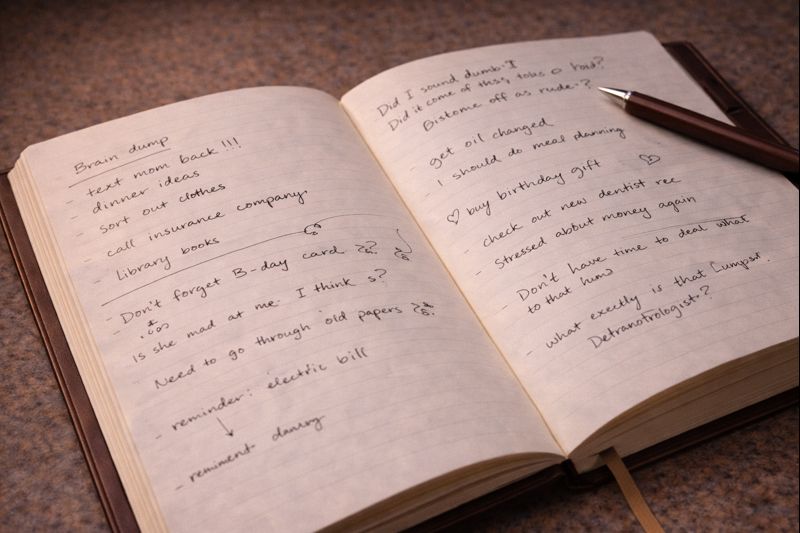
Why Doing “Nothing” Doesn’t Actually Rest Your Brain
We’ve been taught that rest looks like stopping.
Sit down.
Lie down.
Zone out.
Scroll.
But mental rest doesn’t come from inactivity.
It comes from closure.
When you stop moving but don’t stop holding, your brain doesn’t interpret that as rest — it interprets it as unstructured time to think more.
That’s why:
- scrolling often leaves you more tired than before
- quiet moments make your thoughts louder
- rest days feel mentally chaotic instead of refreshing
Your brain doesn’t want silence.
It wants containment.

Cognitive Residue: The Invisible Weight You’re Carrying
There’s a concept called cognitive residue — the mental energy that lingers after a task, thought, or emotion hasn’t been fully closed.
Every unfinished loop leaves a trace.
A decision you haven’t made yet.
A message you need to respond to.
A worry you don’t have an answer for.
A feeling you didn’t process because you had to keep going.
Individually, these things seem small.
Collectively, they create a constant sense of mental busyness — even on “easy” days.
You’re not tired because you’re doing too much.
You’re tired because your brain is carrying too many open tabs.

Why Productivity Advice Often Makes Mental Clutter Worse
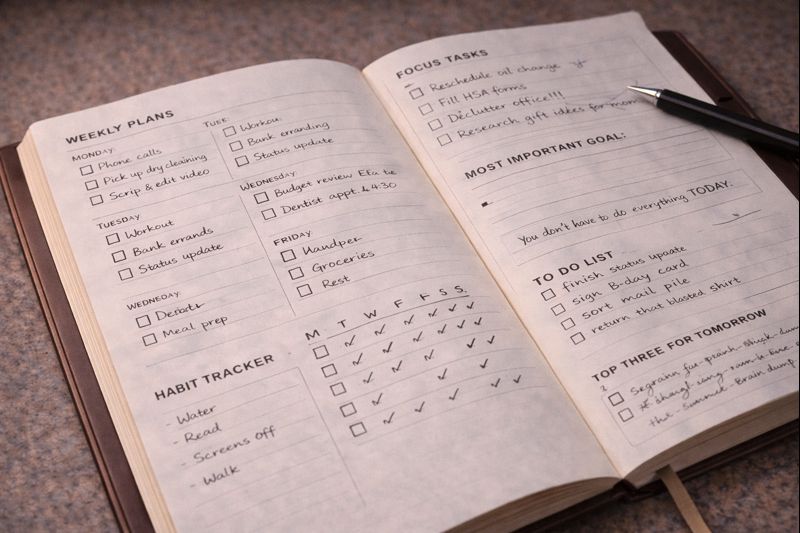
Most productivity systems assume your brain is calm and regulated.
They tell you to:
- prioritize better
- plan further ahead
- optimize your workflow
- “just get it all out on a to-do list”
But for someone with heavy mental clutter, those systems often add more cognitive load.
More categories.
More decisions.
More places to track things.
More pressure to keep up with the system itself.
Instead of relieving mental noise, they give your brain another job.
This is why so many people feel worse after trying to “get organized.”
The problem isn’t that you’re bad at systems.
It’s that your brain needs fewer containers, not more tasks.
Mental Clutter Isn’t a Personal Failure — It’s a Survival Skill
Here’s something important that rarely gets said:
Mental clutter often forms because you’re responsible.
You remember things so nothing falls apart.
You track emotional undercurrents so conflict doesn’t erupt.
You keep plans in your head because there hasn’t been space to deal with them properly.
Your brain learned to hold everything because it had to.
That doesn’t mean it should keep doing it forever.
But it does mean you deserve compassion — not correction.
Cognitive Rest vs. Productivity Rest
Most people think rest means “not working.”
But cognitive rest is different.
Cognitive rest means:
- thoughts have somewhere safe to land
- nothing important is relying on your memory alone
- your brain doesn’t have to stay alert “just in case”
It’s the difference between:
- lying down while thinking nonstop
- and feeling mentally spacious, even while moving
Real rest happens when your brain feels contained, not idle.
If your mental exhaustion feels tied to emotional weight you’ve been carrying for a long time, this piece may help deepen the process:
The Emotional Decluttering Ritual: How to Clean Your Life Without Cleaning Your House
That post focuses on releasing emotional residue — while this one focuses on mental load. Together, they create a full picture.
Why Writing Things Down Isn’t About Productivity
You’ve probably been told to “write it down” before.
But most advice frames writing as a way to do more.
What if writing wasn’t about output at all?
What if it was about relief?
When thoughts live only in your head, your brain treats them as unfinished and urgent.
When they live on paper, your brain can finally stand down.
This is why brain dumps can feel oddly calming — when they’re done without judgment or pressure to act.
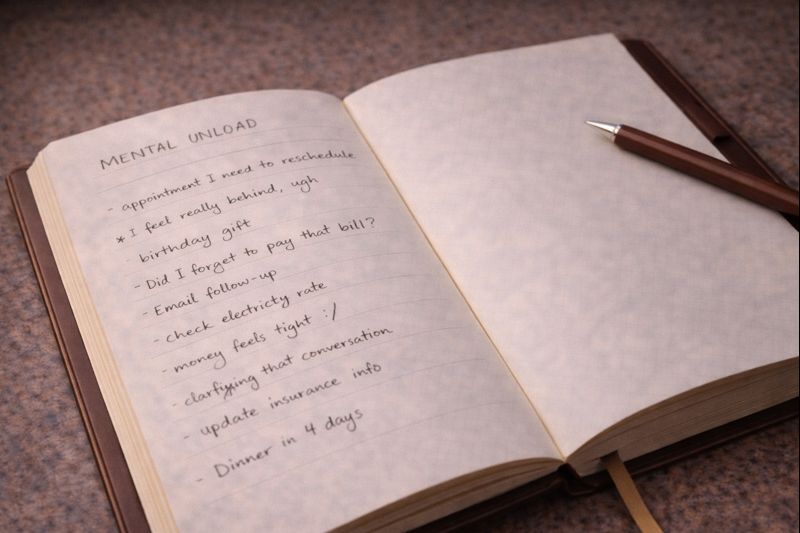
🕯️Mental Unload / Brain Dump Ritual Pages
This is where Mental Unload Pages come in — not as a to-do list, but as a release valve.
The purpose isn’t to organize your thoughts.
It’s to remove them from your body.
A place where:
- nothing has to be prioritized
- nothing has to be solved immediately
- nothing has to turn into action
Just containment.
For many people, this is the first time their brain experiences real quiet — not because thoughts stopped, but because they finally had somewhere else to go.
Why Minimal Systems Feel Safer to an Overloaded Brain
When your mind is already full, complexity feels threatening.
That’s why:
- overly designed planners feel overwhelming
- too many sections create avoidance
- highly optimized systems feel like another obligation
White space isn’t empty.
It’s permission.
A minimal system tells your brain:
“You don’t have to manage this. You can just exist here.”
That sense of safety is what allows mental load to drop.
The Difference Between “Organizing” and “Containing”
Organizing asks:
- What category does this belong in?
- What’s the best way to structure this?
- How can I optimize this?
Containing asks:
- Where can this live so I don’t have to carry it?
If you’re mentally exhausted, containment is almost always the better first step.
You can organize later — if you even need to.
If you struggle with restarting after mental shutdown or avoidance, this system complements what you’re building here:
The Witch’s System for Getting Everything Done (Without Burning Out)
That post focuses on returning gently after overwhelm — this one focuses on preventing overload in the first place.
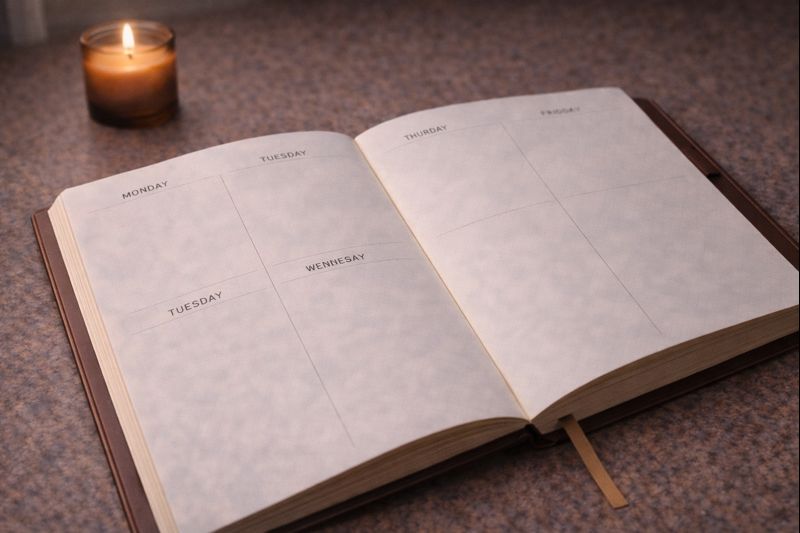
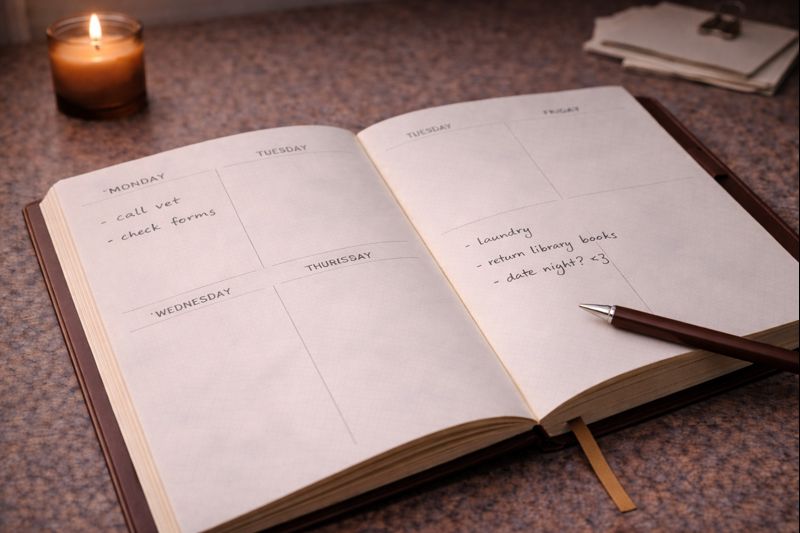
🕯️ Minimal Undated Planner / Mental Reset Pages
For ongoing cognitive rest, many people need a system that doesn’t expire or demand consistency.
Undated, minimal planners work because:
- there’s no guilt about missed days
- no pressure to “keep up”
- no sense of failure when life gets heavy
They act as mental anchors, not schedules.
A place you can return to — not something you have to maintain.
Rituals That Actually Create Cognitive Rest
Here are a few gentle practices that reduce mental clutter without turning into chores:
1. The End-of-Day Mental Sweep
Write down everything that’s still rattling around — tasks, thoughts, worries.
Nothing gets judged. Nothing gets solved.
2. “Nothing Stays in My Head Overnight”
A boundary ritual where your brain learns it doesn’t have to stay alert after a certain hour.
3. Weekly Thought Containment
Once a week, unload recurring thoughts so they don’t keep resurfacing daily.
These aren’t productivity tools.
They’re nervous-system tools.
How to Tell When You’ve Had Real Cognitive Rest
You’ll know you’ve experienced real mental rest when:
- your inner voice softens
- reminders stop popping up randomly
- you feel less rushed without trying
- you’re able to focus gently, not forcefully
It doesn’t feel dramatic.
It feels spacious.

A Gentle Closing Ritual
Tonight, try this:
Write down one thing you’ve been carrying in your head — just one.
Not to fix it.
Not to plan it.
Not to make it productive.
Just to let it live somewhere else.
Then close the page.
Let your brain rest knowing it doesn’t have to hold everything alone anymore.
If your mind has been tired in ways sleep doesn’t fix, you’re not broken.
You’re overloaded.
And with the right containers, that weight can finally come down.


3 Responses