Winter doesn’t just feel heavier emotionally — it often feels heavier financially.
Heating bills rise. Grocery costs creep up. Seasonal expenses pile on quietly. And motivation drops at the exact moment we’re told to “get our finances together.”
It’s a cruel mismatch.
Winter asks you to slow down, conserve energy, and retreat inward — while traditional budgeting advice demands discipline, optimization, and constant attention. No wonder money feels harder during this season.
If you’ve ever felt ashamed for avoiding your budget in winter, this post is for you. Not because you’re doing anything wrong — but because most money systems ignore how seasons actually affect the human nervous system.
This is a gentler way to plan money in winter — one that works with your energy instead of against it.
Winter Isn’t the Problem — Mismatch Is
Most budgeting advice assumes:
- Stable energy
- Consistent motivation
- Clear focus
- Willpower on demand
Winter offers none of those.
Biologically and psychologically, winter is a season of:
- Lower dopamine
- Reduced daylight
- Slower cognitive processing
- Increased need for comfort and safety
That doesn’t make you bad with money.
It makes you human.
The problem isn’t winter spending — it’s forcing summer-style financial systems onto winter energy.
Why Money Feels More Emotional in Winter
Money is never just math.
In winter, money becomes emotionally charged because it’s tied directly to safety.
Heat. Food. Shelter. Gifts. Travel. Family obligations. Emergency buffers.
Your brain doesn’t see a spreadsheet — it sees survival.
That’s why:
- Avoiding your budget feels safer than opening it
- Spending for comfort feels necessary, not indulgent
- Financial decisions feel heavier and more personal
This is also why guilt-based budgeting backfires hardest in winter. Shame increases stress, and stress increases avoidance.
You don’t need more pressure.
You need containment.

The Winter Budgeting Lie We’ve All Been Sold
You’ve probably heard some version of this advice:
“Winter is the perfect time to get serious about money.”
But serious doesn’t mean harsh.
Most winter budgeting advice pushes:
- Strict no-spend rules
- Aggressive savings goals
- “New year, new discipline” energy
That approach ignores one crucial truth:
Winter is not a growth season. It’s a maintenance season.
Your goal in winter isn’t financial transformation.
It’s financial stability without emotional collapse.

A Gentler Winter Budget Starts With Fewer Decisions
Decision fatigue is one of the biggest hidden money drains in winter.
Every choice costs energy:
- Can I afford this?
- Should I wait?
- Am I being irresponsible?
- What if something goes wrong?
When energy is low, too many decisions create paralysis — not control.
That’s why winter budgeting should focus on defaults, not constant evaluation.
Instead of asking “Is this allowed?”
Ask “What’s already decided?”
Shrink the Budget, Not Your Standards
One of the biggest winter mistakes is trying to overhaul your entire financial life at once.
Winter-friendly budgeting works by shrinking the scope, not lowering expectations.
That means:
- Fewer categories
- Fewer goals
- Fewer tracking rules
- Shorter planning windows
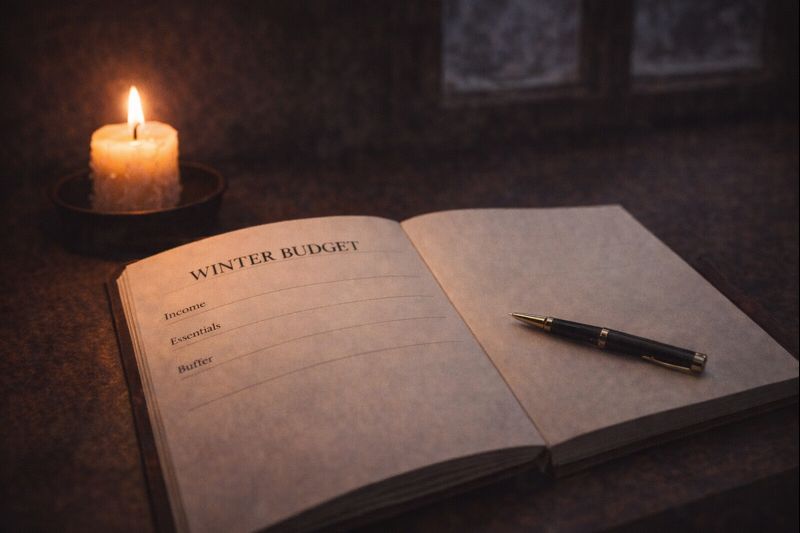
A winter budget might only answer three questions:
- Are my essentials covered?
- Do I have a small buffer?
- Am I spending in a way that feels emotionally sustainable?
That’s enough.
Comfort Spending Isn’t Failure — It’s Information
Winter spending patterns often reveal:
- What makes you feel safe
- Where you’re seeking warmth
- What’s missing emotionally
Instead of trying to eliminate comfort spending, observe it.
Are you spending more on:
- Warm drinks?
- Takeout?
- Small treats?
- Home comforts?
That’s not moral failure. It’s your nervous system asking for regulation.
A gentler winter budget plans for comfort instead of pretending it won’t happen.

The Witchy Approach: Money as Ritual, Not Control
Traditional budgeting frames money as something to dominate.
A witchy approach treats money as something to tend.
Ritual-based budgeting focuses on:
- Regular check-ins instead of constant tracking
- Predictable routines instead of emotional decision-making
- Safety and grounding over perfection
This might look like:
- One weekly money ritual instead of daily monitoring
- A consistent layout you don’t redesign every month
- Reusing the same planning pages so your brain feels familiar, not overwhelmed
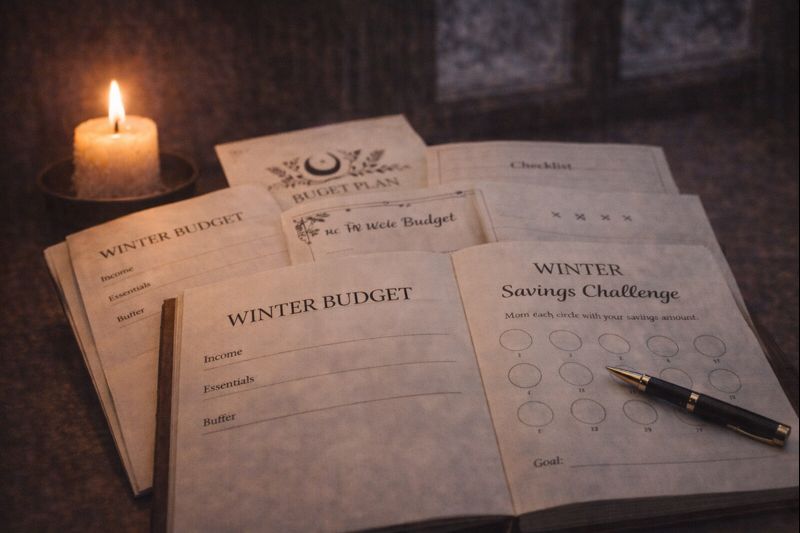
This is where a Witchy Budget Planner Printable can be helpful — not as a productivity tool, but as a container. A place where money lives, so it doesn’t spill into everything else.

When Winter Feels Overwhelming Beyond Money
If winter itself feels heavy — emotionally, physically, mentally — beyond just finances, I’ve written a more general guide to cozy winter routines and rituals here:
→ The Cozy Witch’s Guide to Surviving Winter
This post focuses on money specifically, but winter energy affects every part of life. Separating those topics helps both feel lighter.
Winter Budgets Need Shorter Time Horizons
Planning months ahead in winter often backfires.
Your energy is variable. Your needs shift quickly. Long-term projections feel abstract and stressful.
Instead:
- Plan weekly or bi-weekly
- Focus on the next 7–14 days
- Revisit often, without judgment
Shorter horizons reduce fear and increase follow-through.
A Winter Budget Planner Printable designed for short-term tracking can support this by keeping money planning small and contained.
Why Savings Feel Harder in Winter (And That’s Okay)
Winter is expensive.
Pretending otherwise leads to shame.
Savings in winter should be reframed as:
- Protection, not progress
- Maintenance, not growth
- Gentle consistency, not aggressive targets
Saving $10 counts.
Saving nothing but avoiding debt counts.
Staying emotionally regulated around money counts.
This is where a Savings Challenge Printable designed for low-pressure participation works better than rigid savings plans.

Money Guilt Peaks When Energy Is Lowest
One reason winter budgeting feels brutal is that guilt shows up when you’re least equipped to handle it.
You’re tired.
You’re cold.
You’re overstimulated.
And then you’re told:
“You should be doing better with money.”
A gentle winter budget removes moral language entirely.
No “good” or “bad” spending.
Only information and care.
The Hidden Cost of Avoiding Your Finances
Avoidance feels protective — but it creates anxiety loops.
The goal isn’t perfect tracking.
It’s regular, low-stress contact.
Even a 5-minute weekly check-in prevents:
- Financial spirals
- Catastrophic thinking
- Surprise expenses
Winter budgeting succeeds when it feels safe to look.
Why This Isn’t About Willpower
If budgeting feels harder in winter, it’s not because you lack discipline.
It’s because:
- Your brain is conserving energy
- Your body is prioritizing safety
- Your environment is demanding more resources
A winter-friendly system respects that reality.
A Simple Winter Money Ritual
Here’s a gentle ritual you can try:
- Light a candle
- Open your budget planner
- Look only at:
- Current balance
- Upcoming essentials
- Write one sentence: “Right now, my money situation is ___.”
No fixing.
No optimizing.
Just awareness.
This builds trust with yourself — which is more powerful than any spreadsheet.
Winter Is Not the Time for Financial Reinvention
It’s the time for:
- Stabilization
- Simplification
- Emotional safety
Transformation comes later.
If you want a broader framework for working with winter energy instead of fighting it, The Winter Witch Productivity Method expands on seasonal alignment without focusing solely on money.
Gentle Budgets Are More Sustainable Than Strict Ones
The goal isn’t to spend less at all costs.
The goal is to:
- Spend consciously
- Reduce emotional fallout
- Feel grounded instead of ashamed
A gentle winter budget might not look impressive — but it will keep you engaged.
And engagement is what actually changes financial outcomes over time.
When Winter Ends, You’ll Be Glad You Were Kind
Spring doesn’t reward people who punished themselves through winter.
It rewards people who survived with their trust intact.
A gentle winter budget ensures that when energy returns, you’re not rebuilding from burnout — you’re building from stability.
Final Thought: Money Should Feel Like Support, Not Threat
Winter already asks a lot.
Your budget shouldn’t be another thing that feels dangerous to open.
Gentle planning isn’t weakness — it’s wisdom.
If you want tools that support this approach, explore planners designed for ritual, containment, and emotional safety, not hustle.
Your finances don’t need fixing.
They need tending.